

No. 22.—Ch’ên’s kung for obtaining his Great Sleep
Kung-Fu, or Tauist Medical Gymnastics, by John Dudgeon, [1895], at sacred-texts.com
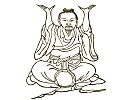
No. 22.—Ch’ên’s kung for obtaining his Great Sleep.—To cure cold caught at any of the Four Seasons. *
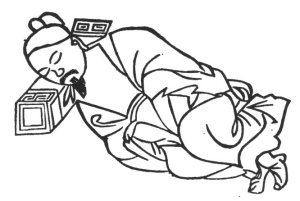
The Ch'iang-hwo (acting) like a Divine Powder.
Footnotes
- 173
173:* p. 175 One of the most frequently occurring names in the works on Kung-fu is Ch‘ĕn Hsi-i, or tw‘an (#), and who seems to have designed many of the Figures for the cure or prevention of disease. The year's Kung-fu is attributed to him. He died about 990 A.D. He was a celebrated Tauist philosopher and recluse, who devoted himself to the study of the arts of sublimation and the occult philosophy of the Yih Ching. He is recognised, as the late lamented and rare sinologue Mr. Mayers says, by Chu Hi as having founded the modern school of interpretation of the system of the diagrams. He was summoned to court of the second Emperor of the Sung dynasty, for the purpose of instructing the Emperor in the mysteries of the arts of sublimation and the occult philosophy of the Book of Changes. The designation by which he is known was conferred upon him by the Emperor. All the works on Kung-fu contain his celebrated Sleeping Recipes. Hence perhaps the popular fable that he slept 800 years. Although he appeared in the Sung dynasty, he is said to have been born in the Chow (1122–249 B.C.). He certainly passed much of his time in meditation, in the exercise of Kung-fu, and this too perhaps may have given rise to the tradition of his long sleep. The popular tradition also asserts that he did not speak till he was seven years old. He lived in a cave at Hwa-shan in Shansi; his bones were buried by order of Kanghi, the Emperor (1662–1723 A.D.), the poor Tauists priest having used his skull for about 1000 years as an object with which to extract alms from the benevolent, the use to which it was put resembling the "wooden fish," a skull-shaped block, the emblem of sleeplessness, on which the priests beat time when chanting.
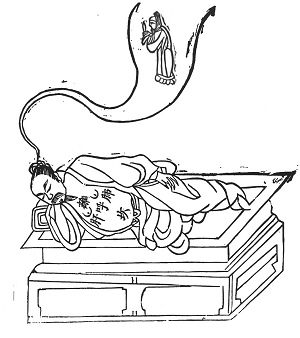
There are illustrations of Ch’ên sleeping on the left and right sides in two of the works consulted. It is accompanied by two poetical stanzas, the last line of the left sleeping hung running thus:—
When the tiger and the dragon are collected together at two of the "Earthly Branches" (related to fire and water), the Great Elixir is complete.
The tiger is here placed on the right, the dragon on the left. In the sleeping exercise for the right side (see illustration), the liver occupies the right and the lungs the left side, with two of the Eight Diagram figures, Li and K‘an (fire and water respectively), above and below, and Hu in the middle, and the whole stanza reads:—
The air of the lungs resides in the place of the K‘an; the liver is directed towards the Li place. Revolve the air (an older work gives spleen air instead), call it to harmonize in the middle position; the five airs (the atmospheric influences or natures of the Five Elements) collect together as one, and enter the great void. (See also Nos. 27 and 33).