

XVI: A Chapter of Questions and Answers
XVI
(A CHAPTER OF QUESTIONS AND ANSWERS)
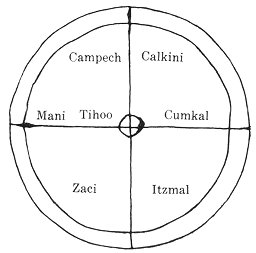
FIG. 27--A map of northern Yucatan. 3 (Chumayel MS.).
13 E¢nab <was the day> when the land was established. 4 13 Cheneb 5 was when they measured off by paces the cathedral, 6 the dark house of instruction,
the cathedral in heaven. Thus it was also measured off by paces here <on earth>. Thirteen katuns was the total count, <that is, thir>teen feet 1 in heaven. Four feet, and from there nine feet, the total count of its extent in heaven. 2 Then it is again measured off by feet from the face of the earth. Four feet separate it from the face of the earth.
Mani is the base of the land. Campeche is the tip of the wing of the land. Calkini is the base of the wing of the land. Itzmal is the middle of the wing of the land. Zaci is the tip of the wing of the land. Conkal is the head of the land. 3
In the middle of the town of Tihoo 4 is the cathedral, the fiery house, 5 the mountainous house, the dark house, for the benefit of God the Father, God the Son and God the Holy Spirit.
Who enters into the house of God? Father, it is the one named Ix-Kalem. 6
What day did the Virgin conceive? Father, 4 Oc <was the day> when she conceived.
What day did he come forth <from her womb>? On 3 Oc he came forth.
What day did he die? On 1 Cimi he died. Then he entered the tomb on 1 Cimi.
What entered his tomb? Father, a coffer of stone entered his tomb.
What entered in into his thigh? 7 Father, it was the red arrow-stone. 8 It entered into the precious stone of the world, there in heaven.
And his arm? Father, the arrow-stone; and that it might be commemorated, 9 /
| p. 68 C |
living rock in the west. Thus also <it entered> the yellow living rock in the south. 1
2 Son, how many deep hollows <are there>? These <are the holes> for playing the flute. 3
Son, where is the cenote? 4 All are drenched <with> its water. 5 There is no gravel on its bottom; a bow is inserted over its entrance. 6 <It is> the church.
Son, where are the first marriages? The strength of the King 7 and the strength of the other head-chiefs fail because of them, and my strength because of them also. It is bread. 8
Son, have you seen the green water-holes in the rock? There are two of them; a cross is raised between them. They are a man's eyes.
Son, where are the first baptised ones? One has no mother, but has a bead collar and little bells. It is peeu. 9
Son, where is the food 10 which bursts forth, and the fold of the brain <and> the lower end of that which is inflated, 11 and the dried fruit? It is the gizzard of a turkey.
Son bring me that which hooks the sky and the hooked tooth. They are a deer and a gopher. 12
Son, where is the old woman with buttocks seven palms wide, the woman with a dark complexion? It is <the squash called> ¢ol. 1
Son, show me the light complexioned woman with her skirt bound up who sells white flints. It is <the squash called> ca. 1
Son, bring me two yellow animals, one to be well boiled, and one shall have its throat cut. I shall drink its blood also. It is a yellow deer and a green calabash full of chocolate.
<My> sons, bring me here a score of those who bear flat stones and two married ones. They are a quail 2 and a dove. 3
Son, bring me a cord of three strands, I wish to see it. It is an iguana.
Son, bring . . . . 4 a mutual confession of sin 5 that I may see it here. It is the maguey. 6
Son, bring me here that which stops the hole in the sky and the dew, the nine layers of the whole earth. 7 It is a very large maize tortilla. 8
Son, have you seen the old man <who is like> an overturned comal? 9 He has a large double chin which reaches the ground. It is a turkey cock.
Son, bring me the old farmers, their beards come to their navels, also their wives. It is a muddy arrowroot. 10
Bring to me here with them the women who guard the fields, white complexioned women. I will remove their skirts and eat them. It is a jícama. 11 /
| p. 69 C |
Son, bring me the great gallants that I may view them. Perhaps they will not dance badly when I see them. It is a turkey-cock.
Son, where is the first collector? <The answer is> to undress, to take off one's shirt, cape, hat and shoes. 1
Son, where was it that you passed? Did you pass, perchance, to the high rocky knoll which slopes down to the door of heaven, where there is a gate in the wall? Did you see men in front of you, coming side by side? Bolon Chaan 2 and the first Ah-kulel 3 are there. It is the pupils of the eyes and any pair of eyes.
Son, have you seen the rain of God? It passed beneath the mountains of God; it entered beneath the mountains of God, where there is a cross on the savannah. 4 There will be a ring in the sky where the water of God has passed.
Son, where has the water of God passed when it comes forth from the living rock? Father, <from> a man's head and all a man's teeth, it passes through the opening in his throat and comes forth beneath.
Son, whom did you see on the road just now? . . . . 5
Son, what did you do with your companions who were coming close behind you? Here are my companions. I have not left them. I await the judgment of God when I shall come to die. This is a man's shadow.
Son, whom did you see on the road? Did you see perchance <some> old men accompanied by <their> boys? Father, here are the old men I saw on the road. They are with me; they do not leave me. This is his great toe with the little <toes>.
Son, where did you see the old women carrying their step-children and their other boys. Father, here they are. They are still with me so that I can eat. I can not leave them yet. It is my thumb and the other fingers.
Son, where did you pass by a water-gutter? 6 Father, here is the water-gutter; it is right with me. This is my dorsal furrow.
Son, where did you see an old man astride a horse across a water-gutter? Father, here is the old man. He is still with me. My shoulders are the horse /
| p. 70 C |
Son, this is the old man with you of which you spoke: it is manifest truth and justice.
Son, go get the heart of the stone and the liver of the earth. . . . 7 I have seen one of them lying on its back, and one lying on its face as though it were
going into hell. They are a Mexican Agouti 1 and a Spotted Agouti, 2 also the first local chief and the first Ah-kulel. 3 As for the heart of the stone, it is the tips of the teeth; and that which covers the opening in the neck of hell is a camote 4 and a jícama.
Son, go and bring me here <the girl> with the watery teeth. 5 Her hair is twisted into a tuft; she is a very beautiful maiden. Fragrant shall be her odor when I remove her skirt and her <other> garment. It will give me pleasure to see her. Fragrant is her odor and her hair is twisted into a tuft. It is an ear of green corn cooked in a pit. 6
Son, then you shall go and get an old man and the herb that is by the sea. The old man is the ac, 7 and <the herb is> a crab.
Son, then you shall go and get the stones from the bottom of a forest pond. 8 It is the tzac. 9
Son, then you shall bring here the stones of the savannah. It is a quail. 10
Also <bring> the first sorcerers, there are four 11 of them. They are the gopher, the Spotted Agouti, the Mexican Agouti and the peccary.
Son, then go and get the thigh of the earth. It is the cassava. 12
Son, go and bring here the green gallant and the green singer. It is a wild turkey <hen> and cock. 13
Son, you shall bring your daughter that I may see her in the sun tomorrow. First the smaller one shall be brought and behind her shall come the larger one. Her hair shall be bound with a feathered band; she shall wear a head-scarf. I will take off her head-scarf. Also the Ah-kulel is behind her. /
| p. 71 C |
Son, then go and get a cluster 1 of Plumeria flowers widely separated. <They should be> there where the sun is tomorrow. <What is meant is> roasted corn and honey.
Here I have rolled that which you have which is flat and round. 2 There are many rolls of it in the cave where you live. Then you shall roll it here that we may see it, when it is time to eat. <It is> a fried egg.
Footnotes
- 125:3
This type of map is fairly typical in Maya documents. Here as usual the principal town, Tihoo (Merida), is in the center; but as a general thing the space between the two outlying circles is divided into compartments, each of which is occupied by the name of one of the border-sites. For a map of this sort see Stephens, 1843, II, p. 264.
- 125:4
- 125:5
- 125:6
- 126:1
- 126:2
- 126:3
- 126:4
- 126:5
- 126:6
- 126:7
- 126:8
- 126:9
- 127:1
Here the text reverts to pure Maya symbolism. The details of the crucifixion of Christ apparently recalled to the Maya mind some of the ceremonies connected with human sacrifice, in which the victim was probably considered the representative of the god. Like the crown of thorns, a paper crown was placed on his head, and the spear which pierced Christ's side appears to have reminded the Maya writer of the arrow with which the priest struck blood from the thigh of the sacrificial victim (Landa 1928, pp. 198-200). It is also possible that the legend of the stone arrow-points, which entered the mythical rocks at the four corners of the world, was associated in the mind of the writer with the rocks which were rent at the time of the crucifixion.
- 127:2
- 127:3
Maya chul, defined as a flute. This is a direct flute or flageolet. An excellent picture of this type of instrument is found in the Dresden Codex (p. 34 A) and plainly shows the finger-holes along the side. Landa states that they were made of cane or reeds. Another wind-instrument employed was a trumpet called hom. This was made of a wooden tube to the end of which was attached a long curved gourd, which probably gave it a flaring mouth. Whistles made of reeds or bones and conch-shells were also blown (Landa 1928, pp. 158-160).
- 127:4
- 127:5
- 127:6
- 127:7
- 127:8
- 127:9
- 127:10
- 127:11
- 127:12
- 128:1
- 128:2
Maya bech, a name applied to Eupsychortyx nigrogularis Nelson (The Yucatan Bob-white), and Dactylortyx thoracicus sharpei Nelson (Yucatan Long-toed Grouse) (Bull. Mus. Comp. Zool. Harvard, vol. 50, p. 116). We have already seen the quail associated with a stone. (p. 94.)
- 128:3
- 128:4
- 128:5
The word for sin used here, tanal, was considered antiquated already in the Sixteenth Century. It has the same meaning in Chol and may have been borrowed from that language (Motul Dictionary; LaFarge 1930, MS.). This mutual confession was an ancient Maya custom and was usually practised in time of sickness when death was imminent (Landa 1928, p. 188).
- 128:6
- 128:7
Like the Mexicans, the Maya appear to have conceived that the world consisted of nine layers. The uppermost was the surface of the earth, and the other eight were the underworlds; in the lowermost reigned the god of the under regions variously called Cumhau and Xibalba in Maya (Motul Dictionary) and Mictlantecuhtli in Nahuatl (Seler 1923, pp. 17 and 22).
- 128:8
- 128:9
- 128:10
- 128:11
- 129:1
- 129:2
Bolon Chaan is probably the name of a deity. It might be translated as Ninth Heaven. We find him mentioned on page 106.
- 129:3
- 129:4
- 129:5
- 129:6
- 129:7
- 130:1
- 130:2
- 130:3
Cf. p. 129, note 3.
- 130:4
- 130:5
Maya, ix ha-liz co. Ix is the regular feminine prefix. Haa means water, and -liz is a suffix indicating possession of what precedes. Co means either a tooth or a kernel of maize. The phrase has been interpreted as "a woman of Jalisco," which would no doubt be rendered Ix Halisco or Ix Halizco in Maya, but Jalisco is so distant from Yucatan that the metaphor seems rather unlikely. Cf. Mediz-Bolio 1930, p. 84.
- 130:6
- 130:7
- 130:8
- 130:9
- 130:10
Cf. p. 94, note 3.
- 130:11
- 130:12
Maya ¢iin, Manihot esculenta Crantz. Cf. p. 96.
- 130:13
Maya cutz and ah-tzo. Ah-tzo is a general term for turkey-cock. Cutz has been identified as Agriocharis ocellata Cuvier, or Ocellated turkey (Bull. Mus. Comp. Zool. Harvard, vol. 50, p. 115). There is another wild turkey found in Yucatan, Meleagris mexicana, which may be called cutz also (Tozzer 1907, p. 22).