

Loss of Time on Sailing Westward
LOSS OF TIME ON SAILING WESTWARD.
Captain Sir J. C. Ross, at p. 132 of his "Antarctic Voyages," says:--
"November 25th. Having by sailing to the eastward gained 12 hours, it became necessary, on crossing the 180th degree, and entering upon west longitude, in order to have our time correspond with that of England, to have two days following of the same date, and by this means lose the time we had gained, and still were gaining as we sailed to the eastward!"
The gaining and losing of time on sailing "round the world" east and west, is generally referred to as another proof of the earth's rotundity. But it is equally as fallacious as the argument drawn from circumnavigation, and from the same cause, namely, the assumption that on a globe only will such a result occur. It will be seen by reference to the following diagram, fig. 88, that such an effect must arise equally upon a plane as upon a globe.
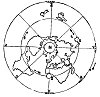
Let V, represent a vessel on the meridian of Greenwich V, N; and ready to start on a voyage eastward; and S, represent the sun moving in an opposite direction, or westward. It is evident that the vessel and the sun being on the same meridian on a given day, if the ship should be stationary the sun would go round in the direction of the arrows, and would meet it again in 24 hours. But if, during the next 24 hours, the ship has sailed to the position X, say 45 degrees of longitude eastward, the sun in its course would meet it three hours earlier than before, or in 21 hours--because 15 degrees of longitude correspond to one hour of time. Hence three hours would be gained. The next day, while the sun is going its round the vessel will have arrived at Y, meeting it 6 hours sooner than it would have done had it remained at V, and, in the same way, continuing its course eastward, the vessel would at length meet the sun at Z, twelve hours earlier than if it had remained at V; and thus passing successively over the arcs 1, 2, and 3, to V, or the starting point, 24 hours, or one day will have been gained. But the contrary follows if the ship sails in the opposite direction. The sun having to come round to the meridian of Greenwich V, S, N, in 24 hours, and the ship having in that time moved on to the position fig. 3, will have to overtake the ship at that position, and thus be three hours longer in reaching it. In this way the sun is more and more behind the meridian time of the ship as it proceeds day after day upon its westerly course, so that on completing the circum-navigation the ship's time is one day later than the solar time, reckoning to and from the meridian of Greenwich.