

VIII. Botany for Painters and Elements of Landscape Painting: 436.
436.
OF A GENERALLY DISTRIBUTED LIGHT AS LIGHTING UP TREES.
The proportions of light and shade in trees (436-440).That part of the trees will be seen to lie in the least dark shadow which is farthest from the earth.
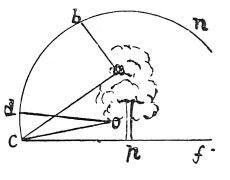
To prove it let a p be the tree, n b c the illuminated hemisphere [the sky], the under portion of the tree faces the earth p c, that is on the side o, and it faces a small part of the hemisphere at c d. But the highest part of the convexity a faces the greatest part of the hemisphere, that is b c. For this reason--and because it does not face the darkness of the earth--it is in fuller light. But if the tree has dense foliage, as the laurel, arbutus, box or holm oak, it will be different; because, although a does not face the earth, it faces the dark [green] of the leaves cut up by many shadows, and this darkness is reflected onto the under sides of the leaves immediately above. Thus these trees have their darkest shadows nearest to the middle of the tree.