

VII. On the Proportions and on the Movements of the Human Figure: 365.
365.
OF PAINTING.
Which are the muscles which subdivide in old age or in youth, when becoming lean? Which are the parts of the limbs of the human frame where no amount of fat makes the flesh thicker, nor any degree of leanness ever diminishes it?
The thing sought for in this question will be found in all the external joints of the bones, as the shoulder, elbow, wrists, finger-joints, hips, knees, ankle-bone and toes and the like; all of which shall be told in its place. The greatest thickness acquired by any limb is at the part of the muscles which is farthest from its attachments.
Flesh never increases on those portions of the limb where the bones are near to the surface.
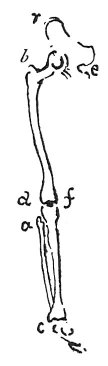
At b r d a c e f the increase or diminution of the flesh never makes any considerable difference. Nature has placed in front of man all those parts which feel most pain under a blow; and these are the shin of the leg, the forehead, and the nose. And this was done for the preservation of man, since, if such pain were not felt in these parts, the number of blows to which they would be exposed must be the cause of their destruction.
Describe why the bones of the arm and leg are double near the hand and foot [respectively].
And where the flesh is thicker or thinner in the bending of the limbs.