
Chapter XIII: Costumes and Customs of Brittany
CHAPTER XIII: COSTUMES AND CUSTOMS OF BRITTANY
DISTINCTIVE national costume has to a great extent become a thing of the past in Europe, and for this relinquishment of the picturesque we have doubtless in a measure to thank the exploitation of remote districts as tourist and sporting centres. Brittany, however, has been remarkably faithful to her sartorial traditions, and even to-day in the remoter parts of the west and in distant sea-coast places her men and women have not ceased to express outwardly the strong national and personal individuality of their race. In these districts it is still possible for the traveller to take a sudden, bewildering, and wholly entrancing step back into the past.
In Cornouaille the national costume is more jealously cherished than in any other part of the country, even to the smallest details, for here the men carry a pen-bas, or cudgel, which is as much a supplement to their attire and as characteristic of it as the Irish shillelagh is of the traditional Irish dress. Quimper is perhaps second to Cornouaille in fidelity to the old costume, for all the men wear the national habit. On gala days this consists of gaily embroidered and coloured waistcoats, which often bear the travelling tailor's name, and voluminous bragou-bras, or breeches of blue or brown, held at the waist with a broad leather belt with a metal buckle and caught in at the knee with ribbons of various hues, the whole set off with black leather leggings and shoes ornamented with silver buckles. A broad-brimmed hat, beneath which the hair falls down sometimes to below the shoulders, finishes a toilet which on weekdays
or work-days has to give place to white bragou-bras of tough material, something more sombre in waistcoats, and the ever serviceable sabot.
Hats and Hymen
In the vast stretch of the salt-pans of Escoublac, between Batz and Le Croisic, where the entire population of the district is employed, the workers, or paludiers, affect a smock-frock with pockets, linen breeches, gaiters, and shoes all of white, and with this dazzling costume they wear a huge, flapping black hat turned up on one side to form a horn-shaped peak. This peak is very important, as it indicates the state of the wearer, the young bachelor adjusting it with great nicety over the ear, the widower above his forehead, and the married man at the back of his head. On Sundays or gala-days, however, this uniform is discarded in favour of a multicoloured and more distinctive attire, the breeches being of fine cloth, exceedingly full and pleated and finished with ribbons at the knees, the gaiters and white shoes of everyday giving place to white woollen stockings with clocks embroidered on them and shoes of light yellow, while the smock is supplanted by several waistcoats, of varying lengths and shades, which are worn one above the other in different coloured tiers, finished at the neck with a turnover muslin collar. The holiday hat is the same, save for a roll of brightly and many tinted chenille.
Several petticoats of pleated cloth, big bibs or plastrons called pièces, of the same shade as their dresses, and a shawl with a fringed border, compose the costume of the women. The aprons of the girls are very plain and devoid of pockets, but the older women's are rich in texture and design, some of them being of silk and
others even of costly brocade. The women's head-dress is almost grotesque in its originality, the hair being woven into two rolls, swathed round with tape, and wound into a coronet across the head. Over this is drawn tightly a kind of cap, which forms a peak behind and is crossed in front like a handkerchief. Should widowhood overtake a woman she relinquishes this coiffe and shrouds her head and shoulders in a rough black triangular-shaped sheepskin mantle.
The toilette of a bride is as magnificent as the widow's is depressing and dowdy. It consists of three different dresses, the first of white velvet with apron of moire-antique, the second of purple velvet, and the third of cloth of gold with embroidered sleeves, with a pièce of the same material. A wide sash, embroidered with gold, is used for looping up all these resplendent skirts in order to reveal the gold clocks which adorn the stockings. These, and all gala costumes, are carefully stored away at the village inn, and may be seen by the traveller sufficiently interested to pay a small fee for the privilege.
Quaint Head-dresses
Though the dress of the Granville women does not attempt to equal or rival the magnificence just described, nevertheless it is as quaint and characteristic. They favour a long black or very dark coat, with bordering frills of the same material and shade, and their cap is a sort of bandeau, turning up sharply at the ears, and crested by a white handkerchief folded square and laid flat on top.
In Ouessant the peasant women adopt an Italian style of costume, their head-dress, from under which their
hair falls loosely, being exactly in almost every detail like that which one associates with the women of Italy. The costume of the man from St Pol is, like that of the Granville women, soberer than most others of Brittany. Save for his buttons, the buckle on his hat, and the clasps of white metal fastening his leather shoes, his dress, including spencer, waistcoat, trousers, and stockings, is of black, and his hair is worn falling on his shoulders, while he rarely carries the pen-bas--an indication, perhaps, of his rather meditative, pious temperament.
At Villecheret the cap of the women is bewilderingly varied and very peculiar. At first sight it appears to consist of several large sheets of stiff white paper, in some cases a sheet of the apparent paper spreading out at either side of the head and having another roll placed across it; in other cases a ridged roof seems to rest upon the hair, a roof with the sides rolling upward and fastened at the top with a frail thread; while a third type of head-dress is of the skull-cap order, from which is suspended two ties quite twenty inches long and eight inches wide, which are doubled back midway and fastened again to the top of the skull-cap. The unmarried woman who adopts this coiffe must wear the ties hanging over the shoulders.
Originality in head-dress the male peasant leaves almost entirely to the woman, for nearly everywhere in Brittany one meets with the long, wide-brimmed, black hat, with a black band, the dullness of which is relieved by a white or blue metal buckle, as large as those usually found on belts. To this rule the Plougastel man is one of the exceptions, wearing a red cap with his trousers and coat of white flannel.
At Muzillac, some miles distant from La Roche-Bernard, the women supplant the white coiffe with a huge black cap resembling the cowl of a friar, while at Pont l’Abbé and along the Bay of Audierne the cap or bigouden is formed of two pieces, the first a species of skull-cap fitting closely over the head and ears, the second a small circular piece of starched linen, shaped into a three-cornered peak, the centre point being embroidered and kept in position by a white tape tie which fastens under the chin. Over the skull-cap the hair is dressed en chignon. The dress accompanying this singular coiffe and coiffure has a large yellow pièce, with sleeves to match. The men wear a number of short coats, one above the other, the shortest and last being trimmed with a fringe, and occasionally ornamented with sentences embroidered in coloured wools round the border, describing the patriotic or personal sentiments of the wearer.
The women of Morlaix are also partial to the tight-fitting coiffe. This consists of five broad folds, forming a base from which a fan-like fall of stiffened calico spreads out from ear to car, completely shading the nape of the neck and reaching down the back below the shoulders. Many of the women wear calico tippets, while the more elderly affect a sort of mob-cap with turned-up edges, from which to the middle of the head are stretched two wide straps of calico, joined together at the ends with a pin. Most of the youths of Morlaix wear the big, flapping hat, but very often a black cloth cap is also seen. This is ridiculous rather than picturesque, for so long is it that with almost every movement it tips over the wearer's nose. The tunic accompanying either hat or cap is of blue flannel, and over it is worn a black waistcoat. The porters of the
market-places wear a sort of smock. The young boys of Morlaix dress very like their elders, and nearly all of them wear the long loose cap, with the difference that a tasselled end dangles down the back. On religious festivals the gala dress is always donned in all vicinities of Brittany, and the costume informs the initiated at once in what capacity the Breton is present. For instance, the porteuses, or banner-bearers, of certain saints are dressed in white; others may be more gorgeously or vividly attired in gowns of bright-coloured silk trimmed with gold lace, scarves of silver thread, aprons of gold tissue or brocade, and lace coiffes over caps of gold or silver tissue; while some, though in national gala dress, will have flags or crosses to distinguish them from the more commonplace worshipper. This dressing for the part and the occasion is interwoven with the Breton's existence as unalterably as sacred and profane elements are into the occasions of his religious festivals. A feast day well and piously begun is interspersed and concluded with a gaiety and abandon which by contrast strikes a note of profanity. Yet Brittany is quite the most devotedly religious of all the French provinces, and one may see the great cathedrals filled to their uttermost with congregations including as many men as women. Nowhere else, perhaps, will one find such great masses of people so completely lost in religious fervour during the usual Church services and the grander and more impressive festivals so solemnly observed. This reverence is attributed by some to the power of superstition, by others to the Celtic temperament of the worshippers; but from whatever cause it arises no one who has lived among the Bretons can doubt the sincerity and childlike faith which lies at the base of it all, a faith of which a medieval simplicity and credence are the keynotes. This pious punctiliousness is not confined to Church services and ceremonies alone, for rarely are wayside crosses or shrines unattended by some simple peasant or peasants telling beads or unfolding griefs to a God Who, they have been taught, takes the deepest interest in and compassionates all the troubles and trials which may befall them. Between May and October the religious ardour of the Breton may be witnessed at its strongest, for during these months the five great 'Pardons' or religious pilgrimage festivals are solemnized in the following sequence: the Pardon of the Poor, at Saint-Yves; the Pardon of the Singers, at Rumengol; the Pardon of the Fire, at Saint-Jean-du-Doigt; the Pardon of the Mountain, at Troménie-de-Saint-Renan; the Pardon of the Sea, at Sainte-Anne-la-Palud. The Pardon of the Poor, the Pardon of the Singers, and the Pardon of the Sea are 'especially rigorous and exacting, but the less celebrated Pardon of Notre Dame de la Clarté, in Morbihan, has an earthly as much as a celestial object, for while the pilgrimage does homage to the Virgin it is at the same time believed to facilitate marriage. Here, once the sacred side of the festival has been duly observed, the young man in search of a wife circles about the church, closely scrutinizing all the eligible demoiselles who come within range of his vision. As soon as he decides which maiden most appeals to him, he asks her politely if she will accept a gift from him, and at the same time presents a large round cake, with which he has armed himself for that occasion. "Will mademoiselle break the cake with me?" is the customary form of address, and in the adoption or rejection of this suggestion lies the young peasant's yea or nay. The Pardon of Saint-Jean-du-Doigt takes place on the 22nd of June, and is, perhaps, the most solemn of these festivals. During its celebration the relic of the Saint, the little finger of his right hand, is held before the high altar of the church by an abbé clad in his surplice. The finger is wrapped in the finest of linen, and one by one the congregation files past the abbé for the purpose of touching for one brief moment the relic he holds. At the same time another cleric stands near the choir, holding the skull of St Mériadec, and before this the pilgrims also promenade, reverently bowing their heads as they go. The devotees then repair to a side wall near which there is a fountain, the waters of which have been previously sanctified by bathing in them the finger of St Jean suspended from a gold chain, and into this the pilgrims plunge their palms and vigorously rub their eyes with them, as a protection against blindness. This concludes the religious side of the Pardon, and immediately after its less edifying ceremonies begin. The Pardon of the Mountain is held on Trinity Sunday at Troménie. Every sixth year there is the 'Grand Troménie,' an event which draws an immense concourse of people from all parts. The principal feature of this great day from the spectator's point of view is the afternoon procession. It is of the most imposing description, and all who have come to take part in the Pardon join it, as with banners flying and much hymn singing it takes its way out of the town to wind round a mountain in the vicinity. In the old days of religious enthusiasm a remarkable phenomenon often attended these festivals, when excitement began to run high, as it was certain to do among a Celtic people. This was the barking of certain highly strung hysterical women. In time it became quite a usual feature, but now, happily, it is a part of the ceremony which has almost entirely disappeared. There is a legend in connexion with this custom that the Virgin appeared before some women disguised as a beggar, and asked for a draught of water, and, when they refused it, caused them and their posterity to be afflicted with the mania. Another custom of earlier times was that of ringing the sacring bell. These bells are very tiny, and are attached at regular intervals to the outer rim of a wooden wheel, wrongly styled by some 'the Wheel of Fortune,' from which dangles a long string. In most places the sacring bell is kept as a curiosity, though in the church of St Bridget at Berhet the Sant-e-roa, or Holy Wheel, is still rung by pilgrims during Mass. The bells are set pealing through the medium of a long string by the impatient suppliant, to remind the saint to whom the Sant-e-roa may be dedicated of the prayerful requests with which he or she has been assailed. There are in many of the churches of Brittany wide, old-fashioned fireplaces, a fact which testifies to a very sensible practice which prevailed in the latter half of the sixteenth century--that of warming the baptismal water before applying it to the defenceless head of the lately born. The most famous of these old fireplaces belong to the churches of St Bridget in Perguet, Le Moustoir-le-Juch, St Non at Penmarch, and Brévélenz. In the church at the latter place one of the pinnacles of the porch forms the chimney to its historic hearth. Childless people often pay a visit to some standing stone in their neighbourhood in the hope that they may thereby be blessed with offspring. Famous in this respect is the 'Venus,' or Groabgoard, of Quinipily, a rough-hewn stone in the likeness of a goddess. The letters . . . LIT . . . still remain on it--part of a Latin inscription which has been thought to have originally read ILITHYIA, "a name in keeping with the rites still in use before the image," says MacCulloch. 1 The holy well is another institution dating from early days, and there is hardly a church in Brittany which does not boast one or more of these shrines, which are in most cases dedicated to the saint in whose honour the church has been raised. So numerous are these wells that to name them and dwell at any length on the curative powers claimed for their waters would fill a large volume. Worthy of mention, however, is the Holy Well of St Bieuzy, as typical of most of such sacred springs. It is close to the church of the same name in Bieuzy, and flows from a granite wall. Its waters are said to relieve and cure the mentally deranged. Some of the wells are large enough to permit the afflicted to bathe in their waters, and of these the well near the church of Goezenou is a good example. It is situated in an enclosure surrounded by stone seats for the convenience of the devotees who may desire to immerse themselves bodily in it. Several of these shrines bear dates, but whether they are genuine is a matter for conjecture. Every Breton churchyard worthy of the name has its reliquary or bone-house. There may be seen rows of small boxes like dog-kennels with heart-shaped openings. Round these openings, names, dates, and pious ejaculations are written. Looking through the aperture, a glimpse of a skull may startle one, for it is a gruesome custom of the country to dig up the bones of the dead and preserve the skulls in this way. The name upon the box is that once borne by the deceased, the date that of his death, and the charitable prayer is for the repose of his soul. Occasionally these boxes are set in conspicuous places in the church, but generally they remain in the reliquary. In the porch of the church of St Trémeur, the son of the notorious Breton Bluebeard, Comorre, there is one of the largest collections of these receptacles in Brittany. Rich people who may have endowed or founded sacred edifices are buried in an arched recess of the abbey or church they have benefited. In some parts of Brittany hollows are found in tomb stones above graves, and these are annually filled with holy water or libations of milk. It would seem as if this custom linked prehistoric with modern practice and that the cup-hollows frequently met with on the top of dolmens may have been intended as receptacles for the food of the dead. The basins scooped in the soil of a barrow may have served the same purpose. On the night of All Souls' Day, when this libation is made, the supper is left spread on the table of each cottage and the fire burns brightly, so that the dead may return to refresh and warm themselves after the dolours of the grave. How hard custom dies in Brittany is illustrated by the fact that it is still usual at Tréguier to convey the dead to the churchyard in a boat over a part of the river called the 'Passage de l’Enfer,' instead of taking the shorter way by land. This custom is reminiscent of what Procopius, a historian of the sixth century, says regarding Breton Celtic custom in his De Bello Gothico. Speaking of the island of Brittia, by which he means Britain, he states that it is divided by a wall. Thither fishermen from the Breton coast are compelled to ferry over at darkest night the shades of the dead, unseen by them, but marshalled by a mysterious leader. The fishermen who are to row the dead across to the British coast must go to bed early, for at midnight they are aroused by a tapping at the door, and they are called in a low voice. They rise and go down to the shore, attracted by some force which they cannot explain. Here they find their boats, apparently empty, yet the water rises to the bulwarks, as if they were crowded. Once they commence the voyage their vessels cleave the water speedily, making the passage, usually a day and a half's sailing, in an hour. When the British shore is reached the souls of the dead leave the boats, which at once rise in the sea as if unloaded. Then a loud voice on shore is heard calling out the name and style of those who have disembarked. Procopius had, of course, heard the old Celtic myth of an oversea Elysium, and had added to it some distorted reminiscence of the old Roman wall which divided Britain. The 'ship of souls' is evidently a feature of Celtic as well as of Latin and Greek belief. Calvaries, or representations of the passion on the Cross, are most frequently encountered in Brittany, so much so, indeed, that it has been called 'the Land of the Calvaries.' Over the length and breadth of the country they are to be met at almost every turn, some of them no more than rude, simple crosses originating in local workshops, and others truly magnificent in carving and detail. Some of the most famous are those situated at Plougastel, Saint-Thégonnec, and Guimiliau. The Calvary of Plougastel dates from the early sixteenth century, and consists of an arcade beneath a platform filled with statues. The surrounding frieze has carvings in bas-relief representing incidents in the life of Christ. The Calvary of Saint-Thégonnec represents vividly the phases of the passion, being really a 'way of the Cross' in sculpture. It bears the unmistakable stamp of the sixteenth century. The Calvary of Guimiliau is dated 1580 and 1588. A platform supported by arches bears the three crosses, the four evangelists, and other figures connected with the principal incidents in the life and passion of our Lord, The principal 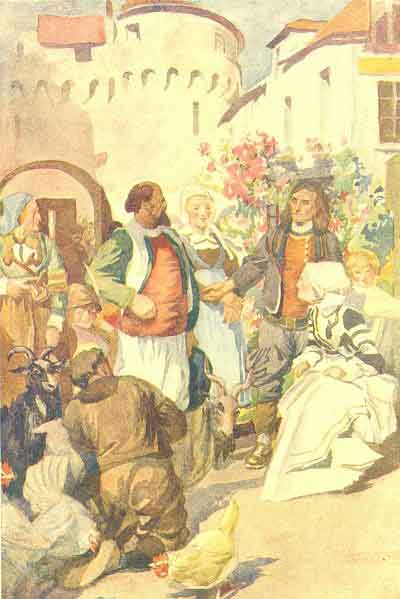
Click to enlarge
MODERN BRITTANY
Religious Festivals
The Pardons
Barking Women
The Sacring Bell
The Venus of Quinipily
Holy wells
Reliquaries
Feeding the Dead
The Passage de l’Enfer
Calvaries