

Lamia or Emipusa
The archive, offline Own the Wisdom of the Ages Every text in the library on a single USB drive. Read offline, cite freely, keep forever. No subscription required. Get the drive $127.00

Lamia or Emipusa

Lamia or Emipusa

A curious creature of the imagination is the lamia, of which we are told many fictitious stories. It is said
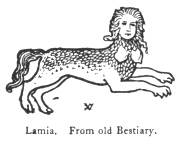
Lamia. From old Bestiary.
to be "the swiftest of all four-footed creatures, that it is very treacherous and cruel to men. It is stated to be bred in Lybia, and sometimes devours its own young." It is represented in an ancient "Bestiaria" as having the head and breasts of a woman, and the body of a four-footed animal with flowing tail, the hind feet having divided hoofs. It is "thought to be the creature mentioned in Isaiah xxxiv., called in Hebrew Lilith, as also the same which is mentioned in Lamentations iv."

In Dr. Brewer's "Dictionary of Phrase and Fable," Lamia is "a female phantom whose name was used by the Greeks and Romans as a bugbear to children, from the classic fable of a Lybian Queen beloved by Jupiter, but robbed of her children by Juno; and in consequence she vowed vengeance against all children, whom she delighted to entice and murder." They are again described as spectres of Africa, who attracted strangers and then devoured them. In the story of "Machatës and Philemon," a young man is represented

p. 221

as marrying an Empusa, who sucks his blood at night. Goethe borrowed his ballad of the "Bride of Corinth" from this tale.

Beyond casual mention this mythical creature does not appear in heraldry.

Read without limits. Membership keeps your reading together and helps the archive grow. $5/mo Become a Member Join

Comments and social are coming soon

Reader conversations and shared activity will appear here.

61 of 76 Book 79% ~1 min left