
Advertisement Join free, go ad-free
IV. Perspective of Disappearance: 260.
The archive, offline Own the Wisdom of the Ages Every text in the library on a single USB drive. Read offline, cite freely, keep forever. No subscription required.
Buy USB Drive Now $127.00
IV. Perspective of Disappearance: 260.
260.
DIFFERENT PORTIONS OF A WALL SURFACE WILL BE DARKER OR BRIGHTER IN PROPORTION AS THE LIGHT OR SHADOW FALLS ON THEM AT A LARGER ANGLE.
The foregoing proposition can be clearly proved in this way. Let us say that m q is the luminous body, then f g will be the opaque
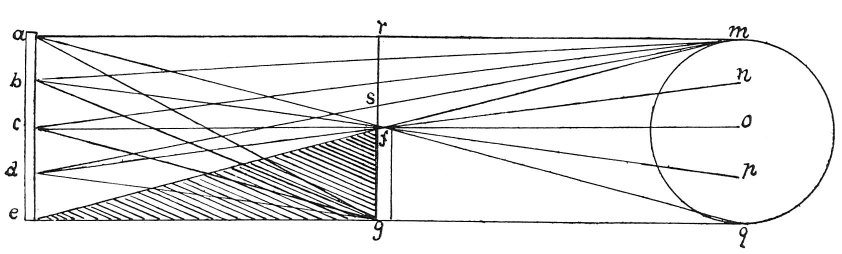
body; and let a e be the above-mentioned plane on which the said angles fall, showing [plainly] the nature and character of their bases. Then: a will be more luminous than b; the base of the angle a is larger than that of b and it therefore makes a greater angle which will be a m q; and the pyramid b p m will be narrower and m o c will be still finer, and so on by degrees, in proportion as they are nearer to e, the pyramids will become narrower and darker. That portion of the wall will be the darkest where the breadth of the
pyramid of shadow is greater than the breadth of the pyramid of light.
At the point a the pyramid of light is equal in strength to the pyramid of shadow, because the base f g is equal to the base r f. At the point d the pyramid of light is narrower than the pyramid of shadow by so much as the base s f is less than the base f g.
Divide the foregoing proposition into two diagrams, one with the pyramids of light and shadow, the other with the pyramids of light [only].
Comments and social are coming soon
Reader conversations and shared activity will appear here.
305 of 1778 Chapter 0% Book 17% ~2 min left