II. Linear Perspective: 78.
78.
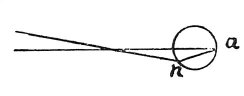
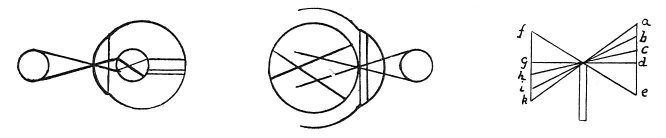
Necessity has provided that all the images of objects in front of the eye shall intersect in two places. One of these intersections is in the pupil, the other in the crystalline lens; and if this were not the case the eye could not see so great a number of objects as it does. This can be proved, since all the lines which intersect do so in a point. Because nothing is seen of objects excepting their surface; and their edges are lines, in contradistinction to the definition of a surface. And each minute part of a line is equal to a point; for smallest is said of that than which nothing can be smaller, and this definition is equivalent to the definition of the point. Hence it is possible for the whole circumference of a circle to transmit its image to the point of intersection, as is shown in the 4th of this which shows: all the smallest parts of the images cross each
other without interfering with each other. These demonstrations are to illustrate the eye. No image, even of the smallest object, enters the eye without being turned upside down; but as it penetrates into the crystalline lens it is once more reversed and thus the image is restored to the same position within the eye as that of the object outside the eye.