
Pale Ink
20 chapters English Public domain
About this book
This is another attempt to investigate early Chinese trans-Pacific contacts, written mid-20th century by a globe-trotting patent attorney, Henriette Mertz. Like Charles Leland's Fusang, written three-quarters of a century before, Mertz depends heavily on ancient Chinese geographical treatises to support her thesis that the Chinese explored the western United States hundreds, maybe thousands of years before Europeans. The strongest part of the book is her attempt to explain the available Chinese historical descriptions, even the most fanciful parts, in terms of specific locations, animals, and cultures, for the most part plausibly. On the downside, she misidentifies parts of the Hindu sacred texts as Buddhist, and indulges in the amateur etymology game, with predictable results. But these factual lapses seem to be peripheral to the book.
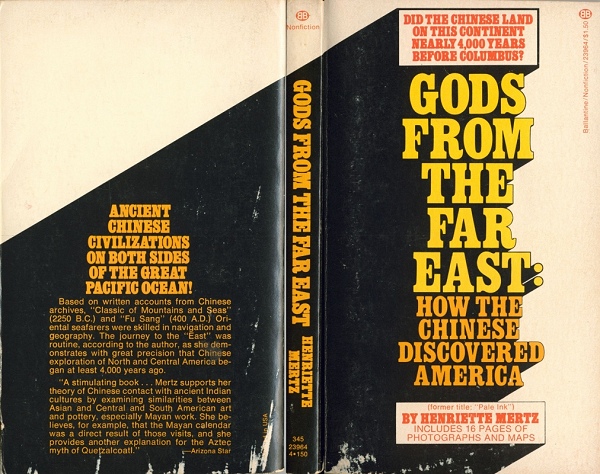
Mertz self-published this in 1953, and followed it up with a second edition in 1972, which corrected many of the endemic typos in the first edition. The book was reissued in paperback by Ballentine in 1975 as Gods from the Far East: How The Chinese Discovered America (see cover), apparently in an effort to cash in on the Van Daniken craze. However, Pale Ink is a much better effort than Van Daniken, as Mertz is not obsessed with explaining every Native American technological advance as a borrowing from unknown visitors.
The Chinese discovery of America continues to be a perennial theory. Most recently we've seen 1421: The Year China Discovered America, by Gavin Menzies, and Voyages of the Pyramid Builders, by Robert M. Schoch. Both of these books owe quite a lot to the work of Henriette Mertz.
Table of contents
20 chapters
01 Start Reading 02 endemic typos 03 Contents 04 Preface 05 Chapter I. Geographical Myths 06 Chapter II. Fu-sang 07 Chapter III. Chinese Whimsy? 08 Chapter IV. Kuen 327 and the Liang-Sse-Kong Ki 09 Chapter V. Mexican Legends 10 Chapter VI. Yucatan 11 Chapter VII. Related Items 12 Chapter VIII. The Buddhists 13 Chapter IX. A Matter of Words 14 Chapter X. Hwui Shan, Traveller par Excellence 15 Chapter XI. Early China 16 Chapter XII. The Shan Hai King 17 Chapter XIII. Across the Sea 18 Chapter XIV. The Great American Desert 19 Chapter XV. Conclusion 20 Author Biography
Audiobook
Listen to this edition
Audiobooks are coming soon
Narrated editions will appear here when they are ready to listen.
Membership
Support the archive
$10 / month
Ad-free reading experience
1,000 Credits monthly for Search usage
Unlimited bookmarks
Unlimited highlights & annotations
Helps fund new texts & growth
Cancel anytime. Helps us pay the bills.
Discussion
Community conversation
Discussions are coming soon
Join conversations around this text and its interpretations.
Pale Ink
20 chapters English Public domain
About this book
This is another attempt to investigate early Chinese trans-Pacific contacts, written mid-20th century by a globe-trotting patent attorney, Henriette Mertz. Like Charles Leland's Fusang, written three-quarters of a century before, Mertz depends heavily on ancient Chinese geographical treatises to support her thesis that the Chinese explored the western United States hundreds, maybe thousands of years before Europeans. The strongest part of the book is her attempt to explain the available Chinese historical descriptions, even the most fanciful parts, in terms of specific locations, animals, and cultures, for the most part plausibly. On the downside, she misidentifies parts of the Hindu sacred texts as Buddhist, and indulges in the amateur etymology game, with predictable results. But these factual lapses seem to be peripheral to the book.
Mertz self-published this in 1953, and followed it up with a second edition in 1972, which corrected many of the endemic typos in the first edition. The book was reissued in paperback by Ballentine in 1975 as Gods from the Far East: How The Chinese Discovered America (see cover), apparently in an effort to cash in on the Van Daniken craze. However, Pale Ink is a much better effort than Van Daniken, as Mertz is not obsessed with explaining every Native American technological advance as a borrowing from unknown visitors.
The Chinese discovery of America continues to be a perennial theory. Most recently we've seen 1421: The Year China Discovered America, by Gavin Menzies, and Voyages of the Pyramid Builders, by Robert M. Schoch. Both of these books owe quite a lot to the work of Henriette Mertz.
Table of contents
20 chapters
01 Start Reading 02 endemic typos 03 Contents 04 Preface 05 Chapter I. Geographical Myths 06 Chapter II. Fu-sang 07 Chapter III. Chinese Whimsy? 08 Chapter IV. Kuen 327 and the Liang-Sse-Kong Ki 09 Chapter V. Mexican Legends 10 Chapter VI. Yucatan 11 Chapter VII. Related Items 12 Chapter VIII. The Buddhists 13 Chapter IX. A Matter of Words 14 Chapter X. Hwui Shan, Traveller par Excellence 15 Chapter XI. Early China 16 Chapter XII. The Shan Hai King 17 Chapter XIII. Across the Sea 18 Chapter XIV. The Great American Desert 19 Chapter XV. Conclusion 20 Author Biography
Audiobook
Listen to this edition
Audiobooks are coming soon
Narrated editions will appear here when they are ready to listen.
Membership
Support the archive
$10 / month
Ad-free reading experience
1,000 Credits monthly for Search usage
Unlimited bookmarks
Unlimited highlights & annotations
Helps fund new texts & growth
Cancel anytime. Helps us pay the bills.
Discussion
Community conversation
Discussions are coming soon
Join conversations around this text and its interpretations.

The archive, offline Own the Wisdom of the Ages Every text in the library on a single USB drive. Read offline, cite freely, keep forever. No subscription required.
Get the drive $127.00
Pale Ink
20 chapters English Public domain
About this book
This is another attempt to investigate early Chinese trans-Pacific contacts, written mid-20th century by a globe-trotting patent attorney, Henriette Mertz. Like Charles Leland's Fusang, written three-quarters of a century before, Mertz depends heavily on ancient Chinese geographical treatises to support her thesis that the Chinese explored the western United States hundreds, maybe thousands of years before Europeans. The strongest part of the book is her attempt to explain the available Chinese historical descriptions, even the most fanciful parts, in terms of specific locations, animals, and cultures, for the most part plausibly. On the downside, she misidentifies parts of the Hindu sacred texts as Buddhist, and indulges in the amateur etymology game, with predictable results. But these factual lapses seem to be peripheral to the book.
Mertz self-published this in 1953, and followed it up with a second edition in 1972, which corrected many of the endemic typos in the first edition. The book was reissued in paperback by Ballentine in 1975 as Gods from the Far East: How The Chinese Discovered America (see cover), apparently in an effort to cash in on the Van Daniken craze. However, Pale Ink is a much better effort than Van Daniken, as Mertz is not obsessed with explaining every Native American technological advance as a borrowing from unknown visitors.
The Chinese discovery of America continues to be a perennial theory. Most recently we've seen 1421: The Year China Discovered America, by Gavin Menzies, and Voyages of the Pyramid Builders, by Robert M. Schoch. Both of these books owe quite a lot to the work of Henriette Mertz.
Table of contents
20 chapters
01 Start Reading 02 endemic typos 03 Contents 04 Preface 05 Chapter I. Geographical Myths 06 Chapter II. Fu-sang 07 Chapter III. Chinese Whimsy? 08 Chapter IV. Kuen 327 and the Liang-Sse-Kong Ki 09 Chapter V. Mexican Legends 10 Chapter VI. Yucatan 11 Chapter VII. Related Items 12 Chapter VIII. The Buddhists 13 Chapter IX. A Matter of Words 14 Chapter X. Hwui Shan, Traveller par Excellence 15 Chapter XI. Early China 16 Chapter XII. The Shan Hai King 17 Chapter XIII. Across the Sea 18 Chapter XIV. The Great American Desert 19 Chapter XV. Conclusion 20 Author Biography
Audiobook
Listen to this edition
Audiobooks are coming soon
Narrated editions will appear here when they are ready to listen.
Membership
Support the archive
$10 / month
Ad-free reading experience
1,000 Credits monthly for Search usage
Unlimited bookmarks
Unlimited highlights & annotations
Helps fund new texts & growth
Cancel anytime. Helps us pay the bills.
Discussion
Community conversation
Discussions are coming soon
Join conversations around this text and its interpretations.