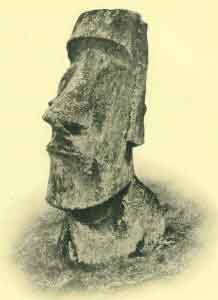
Cover for Te Pito Te Henua, Or Easter Island
Title

Te Pito Te Henua, Or Easter Island

Author
William J. Thomson
Pacific Islander Religions / Public domain
Details
66 chapters English Public domain
About this book

Easter Island is a surreal landscape, with its giant stone heads and undeciphered rongo-rongo script--the only writing system invented in the Pacific islands. This account of an expedition to Easter Island in the late nineteenth century will have modern social scientists (as well as indigenous rights activists) gritting their teeth. The adventurers engage in tomb-raiding from one end of Easter Island to the other, shredding priceless archeological contexts without remorse. The text describes bones turning into dust on touch; they loot gravesites, and tear up ruins of villages. When one of the Easter Islanders complains that they are taking his ancestors' remains, they offer him two dollars for the bones.

The one redeeming feature of this expedition was the desperate attempt to prompt one of the last remaining indigenous bards to relate the rongo-rongo texts and other legends. The circumstances of this recital are greatly suspect. The informant had been indoctrinated by missionaries that reciting from the tablets was a mortal sin. After the expedition attempted to bribe the informant, he fled into the hinterlands. A rainstorm forced him to return to his house. On the last evening before the expedition set sail, they cornered him in his hut and got him drunk, after convincing him that reciting from a photograph was not the same as reciting from the original tablet. To further confuse matters, at one point they switched photographs on him mid-recital...

The monograph has slighly retouched photographs of several of the tablets, reproduced here, which will be very useful to anyone interested in attempting to decipher rongo-rongo. The 'translations', such as they are, remain a key piece of data in any investigation of the script. Also of interest is the version of the Easter Island migration legend quoted here, which claims that they came from the direction of the rising sun. This has been used subsequently to justify a South American origin, most notably by Thor Heyerdal; however it has been contradicted by other accounts, so it should not be treated as absolutely authoritative. This document also has a sketchy vocabulary of the language of Easter Island (Rapanui).

Table of contents

66 chapters

Audiobook

Listen to this edition

Audiobooks are coming soon

Narrated editions will appear here when they are ready to listen.

Membership

Support the archive

$10 / month
Helps fund new texts & growth
Unlimited highlights & annotations
Unlimited bookmarks
Ad free reading experience
Early access to new features
Early access to quality TTS Audiobooks
Priority support & feature requests
4,000 Points monthly for Search usage
Access to point system rewards and value
Become a Member

Cancel anytime. Helps us pay the bills.

Discussion

Community conversation

Discussions are coming soon

Join conversations around this text and its interpretations.

Cover for Te Pito Te Henua, Or Easter Island
Title

Te Pito Te Henua, Or Easter Island

Author
William J. Thomson
Pacific Islander Religions / Public domain
Details
66 chapters English Public domain
About this book

Easter Island is a surreal landscape, with its giant stone heads and undeciphered rongo-rongo script--the only writing system invented in the Pacific islands. This account of an expedition to Easter Island in the late nineteenth century will have modern social scientists (as well as indigenous rights activists) gritting their teeth. The adventurers engage in tomb-raiding from one end of Easter Island to the other, shredding priceless archeological contexts without remorse. The text describes bones turning into dust on touch; they loot gravesites, and tear up ruins of villages. When one of the Easter Islanders complains that they are taking his ancestors' remains, they offer him two dollars for the bones.

The one redeeming feature of this expedition was the desperate attempt to prompt one of the last remaining indigenous bards to relate the rongo-rongo texts and other legends. The circumstances of this recital are greatly suspect. The informant had been indoctrinated by missionaries that reciting from the tablets was a mortal sin. After the expedition attempted to bribe the informant, he fled into the hinterlands. A rainstorm forced him to return to his house. On the last evening before the expedition set sail, they cornered him in his hut and got him drunk, after convincing him that reciting from a photograph was not the same as reciting from the original tablet. To further confuse matters, at one point they switched photographs on him mid-recital...

The monograph has slighly retouched photographs of several of the tablets, reproduced here, which will be very useful to anyone interested in attempting to decipher rongo-rongo. The 'translations', such as they are, remain a key piece of data in any investigation of the script. Also of interest is the version of the Easter Island migration legend quoted here, which claims that they came from the direction of the rising sun. This has been used subsequently to justify a South American origin, most notably by Thor Heyerdal; however it has been contradicted by other accounts, so it should not be treated as absolutely authoritative. This document also has a sketchy vocabulary of the language of Easter Island (Rapanui).

Table of contents

66 chapters

Audiobook

Listen to this edition

Audiobooks are coming soon

Narrated editions will appear here when they are ready to listen.

Membership

Support the archive

$10 / month
Helps fund new texts & growth
Unlimited highlights & annotations
Unlimited bookmarks
Ad free reading experience
Early access to new features
Early access to quality TTS Audiobooks
Priority support & feature requests
4,000 Points monthly for Search usage
Access to point system rewards and value
Become a Member

Cancel anytime. Helps us pay the bills.

Discussion

Community conversation

Discussions are coming soon

Join conversations around this text and its interpretations.

Cover for Te Pito Te Henua, Or Easter Island
Title

Te Pito Te Henua, Or Easter Island

Author
William J. Thomson
Pacific Islander Religions / Public domain
Details
66 chapters English Public domain
About this book

Easter Island is a surreal landscape, with its giant stone heads and undeciphered rongo-rongo script--the only writing system invented in the Pacific islands. This account of an expedition to Easter Island in the late nineteenth century will have modern social scientists (as well as indigenous rights activists) gritting their teeth. The adventurers engage in tomb-raiding from one end of Easter Island to the other, shredding priceless archeological contexts without remorse. The text describes bones turning into dust on touch; they loot gravesites, and tear up ruins of villages. When one of the Easter Islanders complains that they are taking his ancestors' remains, they offer him two dollars for the bones.

The one redeeming feature of this expedition was the desperate attempt to prompt one of the last remaining indigenous bards to relate the rongo-rongo texts and other legends. The circumstances of this recital are greatly suspect. The informant had been indoctrinated by missionaries that reciting from the tablets was a mortal sin. After the expedition attempted to bribe the informant, he fled into the hinterlands. A rainstorm forced him to return to his house. On the last evening before the expedition set sail, they cornered him in his hut and got him drunk, after convincing him that reciting from a photograph was not the same as reciting from the original tablet. To further confuse matters, at one point they switched photographs on him mid-recital...

The monograph has slighly retouched photographs of several of the tablets, reproduced here, which will be very useful to anyone interested in attempting to decipher rongo-rongo. The 'translations', such as they are, remain a key piece of data in any investigation of the script. Also of interest is the version of the Easter Island migration legend quoted here, which claims that they came from the direction of the rising sun. This has been used subsequently to justify a South American origin, most notably by Thor Heyerdal; however it has been contradicted by other accounts, so it should not be treated as absolutely authoritative. This document also has a sketchy vocabulary of the language of Easter Island (Rapanui).

Table of contents

66 chapters

Audiobook

Listen to this edition

Audiobooks are coming soon

Narrated editions will appear here when they are ready to listen.

Membership

Support the archive

$10 / month
Helps fund new texts & growth
Unlimited highlights & annotations
Unlimited bookmarks
Ad free reading experience
Early access to new features
Early access to quality TTS Audiobooks
Priority support & feature requests
4,000 Points monthly for Search usage
Access to point system rewards and value
Become a Member

Cancel anytime. Helps us pay the bills.

Discussion

Community conversation

Discussions are coming soon

Join conversations around this text and its interpretations.