
Advertisement Join free, go ad-free
XV. Astronomy: 895.

The archive, offline Own the Wisdom of the Ages Every text in the library on a single USB drive. Read offline, cite freely, keep forever. No subscription required.
Buy USB Drive Now $127.00
XV. Astronomy: 895.
895.
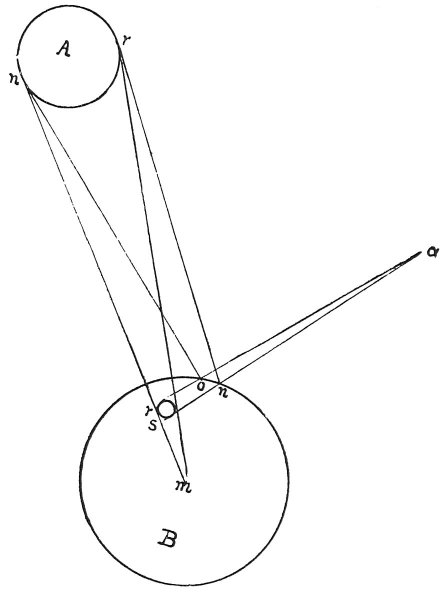
Either the moon has intrinsic luminosity or not. If it has, why does it not shine without the aid of the sun? But if it has not any light in itself it must of necessity be a spherical mirror; and if it is a mirror, is it not proved in Perspective that the image of a luminous object will never be equal to the extent of surface of the reflecting body that it illuminates? And if it be thus 468 , as is here shown at r s in the figure, whence comes so great an extent of radiance as that of the full moon as we see it, at the fifteenth day of the moon?
Footnotes
Comments and social are coming soon
Reader conversations and shared activity will appear here.
1041 of 1778 Chapter 0% Book 58% ~1 min left