
Advertisement Join free, go ad-free
V. Theory of Colours: 276.
The archive, offline Own the Wisdom of the Ages Every text in the library on a single USB drive. Read offline, cite freely, keep forever. No subscription required.
Buy USB Drive Now $127.00
V. Theory of Colours: 276.
276.
OF THE COLOURS OF SIMPLE DERIVED SHADOWS.
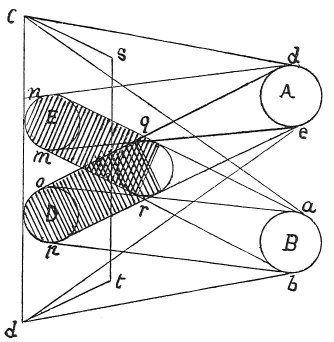
The colour of derived shadows is always affected by that of the body towards which they are cast. To prove this: let an opaque body be placed between the plane s c t d and the blue light d e and the red light a b, then I say that d e, the blue light, will fall on the whole surface s c t d excepting at o p which is covered by the shadow of the body q r, as is shown by the straight lines d q o e r p. And the same occurs with the light a b which falls on the whole surface s c t d excepting at the spot obscured by the shadow q r; as is shown by the lines d q o, and e r p. Hence we may conclude that the shadow n m is exposed to the blue light
d e; but, as the red light a b cannot fall there, n m will appear as a blue shadow on a red background tinted with blue, because on the surface s c t d both lights can fall. But in the shadows only one single light falls; for this reason these shadows are of medium depth, since, if no light whatever mingled with the shadow, it would be of the first degree of darkness &c But in the shadow at o p the blue light does not fall, because the body q r interposes and intercepts it there. Only the red light a b falls there and tinges the shadow of a red hue and so a ruddy shadow appears on the background of mingled red and blue.
The shadow of q r at o p is red, being caused by the blue light d e; and the shadow of q r at o' p' is blue being caused by the red light a b. Hence we say that the blue light in this instance causes a red derived shadow from the opaque body q' r', while the red light causes the same body to cast a blue derived shadow; but the primary shadow [on the dark side of the body itself] is not of either of those hues, but a mixture of red and blue.
The derived shadows will be equal in depth if they are produced by lights of equal strength and at an equal distance; this is proved. 122
Footnotes
Comments and social are coming soon
Reader conversations and shared activity will appear here.
323 of 1778 Chapter 0% Book 18% ~2 min left