Sacred Texts UFOs Mars Index Previous Next
Buy this Book at Amazon.com
From India to the Planet Mars, by Théodore Flournoy; tr. Daniel B. Vermilye, [1900], at sacred-texts.com
OF the various automatic phenomena, the "speaking in tongues" is one which at all times has most aroused curiosity, while at the same time little accurate knowledge concerning it has been obtainable, on account of the difficulty of collecting correctly the confused and unintelligible words as they gush forth.
The phonograph, which has already been employed in some exceptional cases, like that of Le Baron, will doubtless some day render inestimable service to this kind of study, but it leaves much still to be desired at the present moment, from the point of view of its practical utilization in the case of subjects not in their right mind, who are not easily manageable, and who will not remain quiet long enough while uttering their unusual words to allow the instrument to be adjusted and made ready.
There are different species of glossolalia. Simple, incoherent utterances, in a state of ecstasy, interspersed with emotional exclamations, which are sometimes produced in certain surcharged religious environments, is another matter altogether from the creation of neologisms, which are met with in the
dream, in somnambulism, mental alienation, or in children. At the same time this fabrication of arbitrary words raises other problems—as, for example, the occasional use of foreign idioms unknown to the subject (at least, apparently), but which really exist. In each of these cases it is necessary to examine further whether, and in what measure, the individual attributes a fixed meaning to the sounds which he utters, whether he understands (or has, at least, the impression of understanding) his own words, or whether it is only a question of a mechanical and meaningless derangement of the phonetic apparatus, or, again, whether this jargon, unintelligible to the ordinary personality, expresses the ideas of some secondary personality. All these forms, moreover, vary in shades and degrees, and there are, in addition, those mixed cases, possibly the more frequent, where all the forms are mingled and combined. The same individual, and sometimes in the course of the same spasm, also exhibits a series of neologisms, comprehended or uncomprehended, giving way to a simple, incoherent verbiage in common language, or vice versa, etc.
A good description and rational classification of all these categories and varieties of glossolalia would be of very great interest. I cannot think of attempting such a study here, having enough already to fully occupy my attention, by reason of having involved myself with the Martian of Mlle. Smith. This somnambulistic language does not consist, as we have already discovered, either in speaking ecstatically or in religious enthusiasm, nor yet in
the use of a foreign language which really exists; it represents rather neologism carried to its highest expression and practised in a systematic fashion, with a very precise signification, by a secondary personality unknown to the normal self. It is a typical case of "glosso-poesy," of complete fabrication of all the parts of a new language by a subconscious activity. I have many times regretted that those who have witnessed analogous phenomena—as, for example, Kerner, with the Seeress of Prevost—have not gathered together and published in their entirety all the products of this singular method of performing their functions on the part of the verbal faculties. Undoubtedly each case taken by itself seems a simple anomaly, a pure arbitrary curiosity, and without any bearing; but who knows whether the collection of a large number of these psychological bibelots, as yet few enough in their total, would not end in some unexpected light? Exceptional facts are often the most instructive.
In order to avoid falling into the same errors of negligence, not knowing where to stop, in case I wished to make a choice, I have taken the course of setting forth here in full all the Martian texts which we have been able to gather. I will have them follow a paragraph containing certain remarks which that unknown language has suggested to me; but, very far from flattering myself that I have exhausted the subject, I earnestly hope that it will find readers more competent than myself to correct and complete my observations, since I must acknowledge that as a linguist and philologist I am very much
like an ass playing the flute. It is expedient, in beginning, to give some further details regarding the various psychological methods of manifestation of that unknown tongue.
I have described in the preceding chapter, and will not now return to it, the birth of the Martian language, indissolubly bound up with that of the romance itself, from the 2d of February, 1896, up to the inauguration of the process of translation by the entrance of Esenale upon the scene on the 2d of November following (see pp. 154-165). During several months thereafter the Martian language is confined to the two psychological forms of apparition in which it seems to have been clothed during the course of that first year.
First: Verbo-auditive automatism, hallucinations of hearing accompanying visions in the waking state. In the case of spontaneous visions, Hélène notes in pencil, either during the vision itself or immediately afterwards, the unintelligible sounds which strike her ear; but to her great regret many of them escape her, since she is sometimes only able to gather the first or the last phrase of the sentences which her imaginary personages address to her, or scattered fragments of conversations which she holds with herself; these fragments themselves often contain inaccuracies, which are ultimately rectified at the moment of translation, Esenale having the good habit of articulating very clearly each Martian word before giving its
[paragraph continues] French equivalent. In the case of the visions which she has at the seances, Hélène slowly repeats the words she hears without understanding them, and the sitters make note of them more or less correctly.
Secondly: Vocal automatism ("verbo-motor hallucinations of articulation," in the cumbersome official terminology). Here again it is the sitters who gather as much as they can of the strange words pronounced in a state of trance, but that is very little, since Hélène, in her Martian state, often speaks with a tremendous volubility. Moreover, a distinction must be made between the relatively clear and brief phrases which are later translated by Esenale, and the rapid and confused gibberish the signification of which can never be obtained, probably because it really has none, but is only a pseudo-language (see pp. 154-159).
A new process of communication, the handwriting, made its appearance in August, 1897, with a delay of perhaps eighteen months as to the speech (the reverse of Leopold's case, who wrote a long time before speaking). It is produced, also, under two forms, which constitute a pendant to the two cases given above, and also complete the standard quartette of the psychological modalities of language.
Thirdly: Verbo-visual automatism—that is, apparitions of exotic characters before Hélène's eyes when awake, who copies them as faithfully as possible in a drawing, without knowing the meaning of the mysterious hieroglyphics.
Fourthly: Graphic automatism—i.e., writing traced
by the hand of Hélène while completely entranced and incarnating a Martian personage. In this case the characters are generally smaller, more regular, better formed than in the drawings of the preceding case. A certain number of occasions, when the name has been pronounced by Hélène before being written, and especially the articulation of Esenale at the moment of translation, have permitted the relations between her vocal sounds and the graphic signs of the Martian language to be established.
It is to be noted that these four automatic manifestations do not inflict an equal injury upon the normal personality of Mlle. Smith. As a rule, the verbo-auditive and verbo-visual hallucinations only suppress her consciousness of present reality; they leave her a freedom of mind which, if not complete, is at least sufficient to permit her to observe in a reflective manner these sensorial automatisms, to engrave them on her memory, and to describe them or make a copy of them, while she often adds remarks testifying to a certain critical sense. On the contrary, the verbo-motor hallucinations of articulation or of writing seem to be incompatible with her preservation of the waking state, and are followed by amnesia. Hélène is always totally absent or entranced while her hand writes mechanically, and if, as seldom happens, she speaks Martian automatically, outside of the moments of complete incarnation, she is not aware of it, and does not recollect it. This incapacity of the normal personality of Mlle. Smith to observe at the time or remember afterwards her verbo motor automatisms denotes
a more profound perturbation than that she experiences during her sensory automatisms.
The Martian handwriting only appeared at the end of a prolonged period of incubation, which betrayed itself in several incidents, and was certainly stimulated by various exterior suggestions during a year and a half at least. The following are the principal dates of this development.
February 16, 1896.—The idea of a special handwriting belonging to the planet Mars occurs for the first time to Hélène's astonishment in a Martian semi-trance (see p. 162).
November 2.—Handwriting is clearly predicted in the phrase, "Astané will teach me to write," uttered by Hélène in a Martian trance, after the scene of the translation by Esenale (see p. 166).
November 8.—After the translation of text No. 3, Leopold, being questioned, replies that Astané will write this text for Mlle. Smith, but the prediction is not fulfilled.
May 23, 1897.—The announcement of Martian handwriting becomes more precise. "Presently," says Astané to Hélène, "thou wilt be able to trace our handwriting, and thou wilt possess in thy hands the characters of our language" (text 12).
June 20.—At the beginning of a seance, a Martian vision, she demands of an imaginary interlocutor "a large ring which comes to a point, and with which one can write." This description applies to M. R., who has with him some small pocket-pens of this kind, capable of being adjusted to the end of the index-finger.
June 23.—I hand Hélène the two small pocket-pens which M. R. has brought for her, but they do not please her. After trying to use one, she throws it away and takes up a pencil, saying that if she must write Martian, the ordinary means will suffice as well as those peculiar pocket-pens. In about a minute she falls asleep, and her hand begins automatically to trace a message in Leopold's handwriting. I then ask that individual whether the pocket-pens of M. R. do not meet the exigencies of Martian, and whether Mlle. Smith will some day write that language, as has already been announced. Hélène's hand thereupon responds in the beautiful calligraphy of Leopold: "I have not yet seen the instrument which the inhabitants of the planet Mars use in writing their language, but I can and do affirm that the thing will happen, as has been announced to you.—Leopold."
June 27.—In the scene of the translation of text 15, Hélène adds to her usual refrain, "Esenale has gone away; he will soon return; he will soon write."
August 3.—Between four and five o'clock in the afternoon Hélène had a vision at her desk, lasting ten or fifteen minutes, of a broad, horizontal bar, flame-colored, then changing to brick-red, and which by degrees became rose-tinted, on which were a multitude of strange characters, which she supposes to be the Martian letters of the alphabet, on account of the color. These characters floated in space before and round about her. Analogous visions occur in the course of the weeks immediately following.
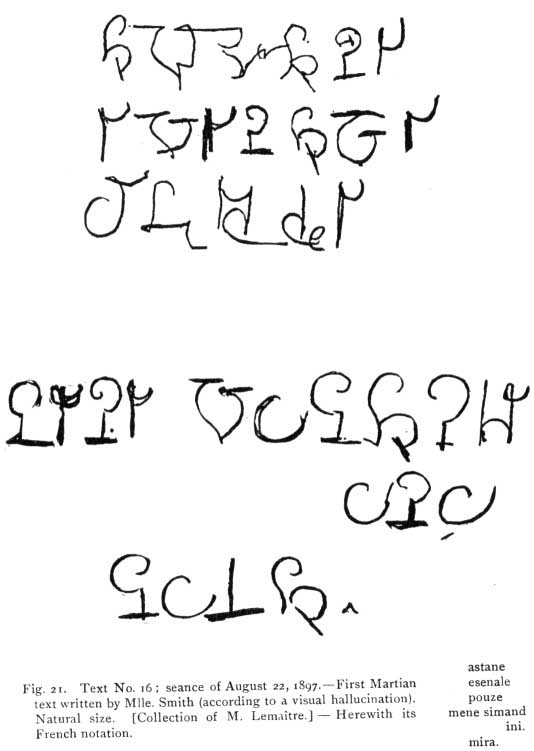
August 22.—Hélène for the first time writes in Martian. After various non-Martian visions Mlle. Smith turns away from the window (it rained hard, and the sky was very gray) and exclaims, "Oh, look, it is all red! Is it already time to go to bed? M. Lemaître, are you there? Do you see how red it is? I see Astané, who is there, in that red; I only see his head and the ends of his fingers; he has no robe; and here is the other (Esenale) with him. They both have some letters at the ends of their fingers on a bit of paper. Quick, give me some paper!" A blank sheet and the pocket-pen are handed to her, which latter she disdainfully throws down. She accepts an ordinary pencil, which she holds in her customary fashion, between her middle and index-finger, then writes from left to right the three first lines of Fig. 21, looking attentively towards the window at her fictitious model before tracing each letter, and adding certain oral notes, according to which there are some words which she sees written in black characters on the three papers—or, more correctly, on three white wands, a sort of narrow cylinder, somewhat flattened out—which Astané, Esenale, and a third personage whose name she does not know but whose description corresponds with that of Pouzé, hold in their right hands. After which she a gain sees another paper or cylinder, which Astané holds above his head, and which bears also some words which she undertakes to copy (the three last lines of Fig. 21, p. 205). " Oh, it is a pity," says she, on coming to the end of the fourth line, "it is all on one line, and I have no more room." She
then writes underneath the three letters of line 5, and without saying anything adds line 6. Then she resumes: "How dark it is with you . . . the sun has entirely gone down" (it still rains very hard). "No one more! nothing more!" She remains in contemplation before that which she has written, then sees Astané again near the table, who again shows her a paper, the same, she thinks, as the former one. "But no, it is not altogether the same there is one mistake, it is there [she points to the fourth line towards the end] . . . Ah, I do not see more!" Then, presently she adds: "He showed me something else; there was a mistake, but I was not able to see it. It is very difficult. While I was writing, it was not I myself, I could not feel my arms. It was difficult, because when I raised my head I no longer saw the letters well. It was like a Greek design."
At this moment Hélène recovered from the state of obscuration, from which she emerged with difficulty, which had accompanied the Martian vision and the automatic copy of the verbo-visual text. But a little later in the evening she only vaguely remembered having seen strange letters, and was altogether ignorant of having written anything.
The very natural supposition that the three first words written were the names of the known personages (Astané, Esenale, Pouzé), who bore them on their wands, led to the discovery of the meaning of many of the Martian characters and permitted the divining of the sense of the three last words.
The new alphabet was enriched by certain other
|
Fig. 21. Text No. 16 seance of August 22, 1897.—First Martian text written by Mlle. Smith (according to a visual hallucination). Natural size. [Collection of M. Lemaître.)—Herewith its French notation. |
|
astane |
signs on the following days, thanks to the echoes of that seance in the ordinary life of Hélène, who happened on several occasions to write not the true Martian as yet, but French in Martian letters, to her great stupefaction when she found herself after a while in the presence of these unknown hieroglyphics.
|
Fig. 22. Examples of isolated French words (française, lumière, prairie) automatically traced in Martian characters by Mlle. Smith in her normal handwriting. See also Fig. 1, p. 56. |
The first manifestation of that graphic automatism, being as yet concerned only with the form of the letters and not the vocabulary, dates from the day after the following seance:
August 23.—"Here," wrote Hélène to me at noon, sending me some memoranda from which I have taken the three examples of Fig. 22—"here are some labels which I made it my business to make this morning at ten o'clock, and which I have not been able to finish in a satisfactory manner. I have only just now emerged from the rose-colored fog in which I have been continuously enwrapped for almost two hours."
Three weeks later a complete automatic Martian handwriting was produced in a seance at my house, of which the following is a summary.
September 12, 1897.—At the end of a quite long Martian vision, Mlle. Smith sees Astané, who has something at the end of his finger and who signs to
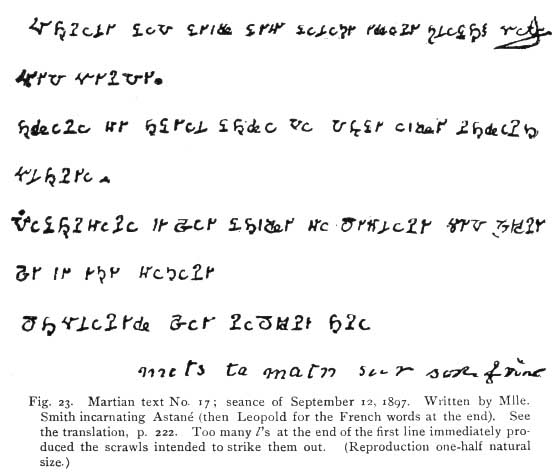
her to write. I offer her a pencil, and after various tergiversations she slowly begins to trace some Martian characters (Fig. 23). Astané has possession of her arm, and she is, during this time, altogether anæsthetic and absent. Leopold, on the contrary, is at hand, and gives various indications of his presence.
|
Fig. 23. Martian text No. 17; seance of September 12, 1897. Written by Mlle. Smith incarnating Astané (then Leopold for the French words at the end). See the translation, p. 222. Too many l’s at the end of the first line immediately produced the scrawls intended to strike them out. (Reproduction one-half natural size.) |
[paragraph continues] At the end of the sixth line she seems to half awaken, and murmurs, "I am not afraid; no, I am not afraid." Then she again falls into a dream in order to write the four last words (which signify "Then do not fear," and which are the response of Astané to her exclamation).
Almost immediately Leopold substitutes himself for Astané and traces on the same sheet, in his characteristic handwriting (considerably distorted towards the end): "Place thy hand on her forehead," by means of which he indicates to me that the time has arrived to pass on to the scene of translation by Esenale.
We may conclude from these successive stages that the Martian handwriting is the result of a slow
|
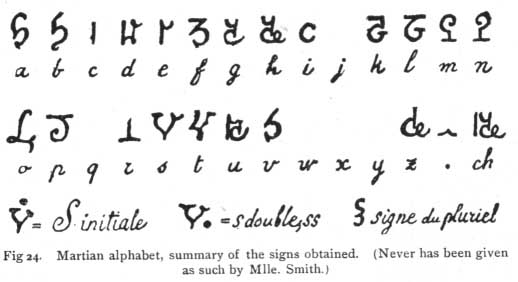
Fig 24. Martian alphabet, summary of the signs obtained. (Never has been given as such by Mlle. Smith.) |
autosuggestion, in which the idea of a special writing instrument, and its handling, for a long time played the dominant rôle, then was abandoned, without doubt, as impracticable to realize. The characters themselves then haunted for several weeks Hélène's visual imagination before they appeared to her on the cylinders of the three Martians in a manner sufficiently clear and stable to enable her to copy them and afterwards to be capable of subduing her graphomotor mechanism. Once manifested outwardly,
these signs, which I have assembled under the form of an alphabet in Fig. 24, have not varied for two years.
Moreover, some trifling confusion, of which I shall speak a little later, shows well that the personality which employs them is not absolutely separated from that of Hélène, although the latter, in a waking state, might hold the same relation to Martian which she holds to Chinese—that is, she knows its general very characteristic aspect, but is ignorant of the signification of the characters, and would be incapable of reading it.
Hélène's Martian handwriting is not stereotyped, but presents, according to circumstances, some variations in form, especially in the size of the letters.
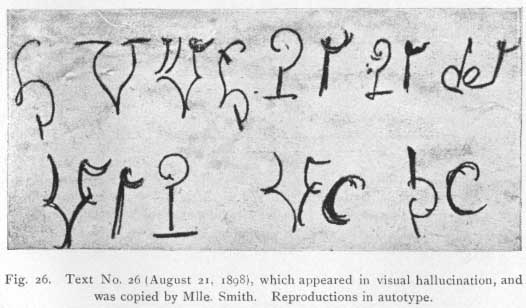
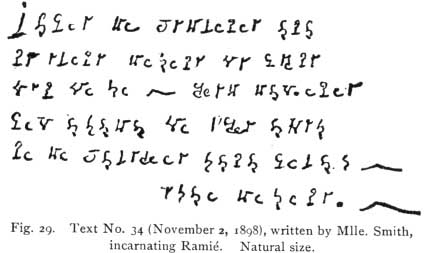
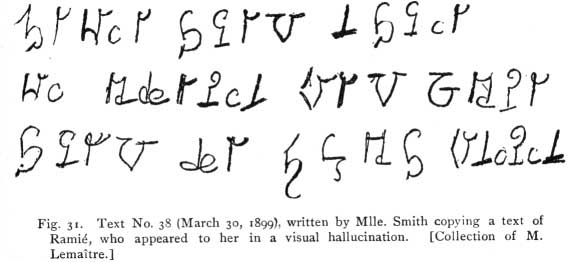
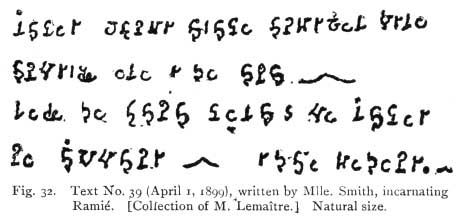
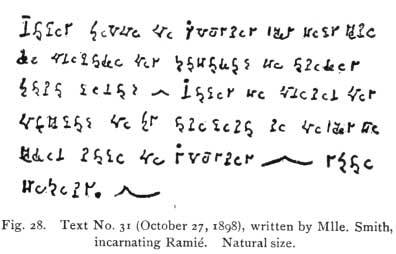
This may be established by Figs. 21 to 32, in which I have reproduced the greater part of the texts obtained by writing. When the Martian gushes forth in verbo-visual hallucinations, Hélène transcribes it in strokes of large dimensions, lacking firmness, full of repetitions (Figs. 21, 26, 31), and she always remarks that the original, which is before her eyes, is much smaller and clearer than her copy. In the texts which have come automatically from her hand—i.e., supposedly traced by the Martians themselves—the handwriting is really smaller and more precise. Here again are some curious differences. Astané has a calligraphy less voluminous than that of Esenale, and Ramié has a much finer one than Esenale (Figs. 28 and 29).
It would be altogether premature for me to launch
myself upon the study of Martian graphology, and, therefore, leaving that line to my successors, I take up the texts which have been collected in their chronological order.
It is not always easy to represent a language and its pronunciation by means of the typographical characters of another. Happily the Martian, in spite of its strange appearance and the fifty millions of leagues which separate us from the red planet, is in reality so near neighbor to French that there is scarcely any difficulty in this case.
The dozen written texts * which we possess, and which Mlle. Smith either copied from a verbo-visual hallucination, or which were traced by her hand in an access of graphomotor automatism, are readily translated into French, since each Martian letter has its exact equivalent in the French alphabet. I have confined myself to placing accents on the vowels (there are none in the Martian writing), conformably to the pronunciation of Esenale at the moment of translation. It is only necessary to read the following texts aloud, articulating them as though they were French, in order to secure the Martian words almost exactly as they proceed from the mouth of M le. Smith; I say almost, because there still remains, naturally, in the speech of Esenale, as in that of every one, a special mannerism
of strengthening certain syllables and slurring others—in short, that of delicate shades of accentuation, which cannot be adequately represented, and which the hearers did not attempt to take note of at the seances.
In the auditive or vocal texts, those which have not been obtained by writing, I have adopted the more probable orthography, according to the pronunciation of Esenale, but (with the exception of words known by means of the written texts) I naturally cannot guarantee their absolute correctness.
The manner in which Hélène takes down in pencil the Martian phrases which strike her ear is not of great assistance to us in that respect, because, as I have said above (p. 158), she finds herself at the time of these verbo-auditive hallucinations in the situation of a person who hears some unknown words, and spells them as well as she is able, after a quite arbitrary and often faulty fashion. She writes, for example, "hezi darri né ciké taisse," which, according to the pronunciation of Esenale and other written texts, should be "êzi darié siké tés"; or, again, "misse messe as si lé," instead of "mis mess ass ilé." We cannot, therefore, depend upon the orthography of Hélène, but I have naturally followed it in every case in which there seemed to be no good reason to depart from it. In stating that the following texts should be articulated like French, two remarks must be added: First, the final consonant, very rare in Martian, is always aspirated; the word ten is pronounced as in the French gluten;
essat, like fat; ames, like aloes; mis and mess, like lis (flower), and mess (of an officer), etc. In the second place, for the different values of the e I have adopted the following rule: the e broad is always indicated by the accent grave è; the e medium, which is only found at the beginning and in the middle of a word, is marked with the acute accent é; the e short, by the acute accent at the end of a word (or before a final e mute), and by the circumflex at the beginning or in the middle; the e mute, or demimute, remains without accent.
The pronunciation, therefore, will be, for example, the e’s of the Martian words mété, bénézee, like those of the French words été, répétée; êvé, like rêvé, tès, as in Lutèce, etc.
There will be found in italics, underneath the Martian texts, their French equivalents, word for word, as given by Esenale in the manner described above (see pp. 166-168). * I have also indicated the kind of automatism—auditive, visual, vocal, or graphic—by means of which each text was obtained, also the date of its appearance, and (in parentheses) that of the seance, often quite remote, at which it was translated. I have also added such explanations as seemed to me to be necessary.
|
1. |
métiche C. |
médache C. |
métaganiche S. |
kin’t’che |
|
|
Monsieur C. |
Madame C. |
Mademoiselle S. |
quatre. |
|
|
Mr. C. |
Mrs. C. |
Miss C. |
Four. |
Vocal. February 2, 1896. See above, p. 157.
|
2. |
dodé |
né |
ci |
haudan |
té |
mess |
métiche |
astané |
ké |
dé |
|
|
Ceci |
est |
la |
maison |
du |
grand |
homme |
Astané |
que |
tu |
|
|
mé |
véche. |
|
|
|
|
|
|
|
|
|
|
as |
vu. |
|
|
|
|
|
|
|
|
This is the house of the great man Astané, whom thou hast seen.
Auditive. About September 20, 1896 (translated November 2).—Heard by Hélène at the same time at which she had the vision of Fig. 12 (see p. 166).
|
3. |
modé |
iné |
cé |
di |
cévouitche |
ni |
êvé |
ché |
kiné |
liné |
|
|
Mère |
adorée, |
je |
te |
reconnais |
et |
suis |
ton |
petit |
Linet. |
Adored mother, I recognize thee, and am thy little Linet.
Words addressed to Mme. Mirbel by her son Alexis (Esenale) in a scene of incarnation altogether analogous to that described on p. 156.
|
4. |
i |
modé |
mété |
modé |
modé |
iné |
palette |
is |
|
|
O |
mère, |
tendre |
mère, |
mère |
bien-aimée, |
calme |
tout |
|
|
ché |
péliché |
ché |
chiré |
né |
ci ten |
ti |
vi |
|
|
ton |
souci, |
ton |
fils |
est |
près |
de |
toi. |
Oh, mother, tender mother, dearly loved mother, calm all thy care, thy son is near thee.
Vocal. November 29, 1896 (translated same seance).—Spoken by Esenale and addressed to Mine. Mirbel, in a scene of incarnation analogous to the preceding. At the moment of translation., Esenale repeated, very distinctly, the last words, as follows: "né ci, est près ["is near"], ten ti vi, de toi ("thee"). This was evidently an error, since it appears from numerous later texts that est près de toi corresponds to né ten ti vi; it follows that it would be natural to translate the word ci by là, ici, or tout, if these words had not been differently rendered in other texts. (A confusion of the adverb là with the article la, translated by ci in text 2, might also be suspected.)
|
5. |
i |
kiché |
ten |
ti |
si |
ké |
di |
êvé dé |
étéche |
mêné |
|
|
Oh! |
pourquoi |
près |
de |
moi |
ne |
te |
tiens-tu |
toujours, |
amie |
|
|
izé |
bénézée |
|
|
|
|
|
|
|
|
|
|
enfin |
retrouvée! |
|
|
|
|
|
|
|
|
Oh! Why dost thou not keep thyself always near me, friend, at last found again?
Auditive. December 4, 1896 (translated December 13). Fragment of a long discourse by Astané to Hélène, during an apparition which she had of him about nine o'clock in the evening, as she was about to go to bed. This sentence, which he uttered twice, is the only one which she has been able to recall with sufficient precision to note down immediately after the vision. She has the feeling of having understood Astané's whole discourse while he was delivering it, and thinks she would have been able to translate it into French, perhaps not word for word, but in its general sense. She expected to transcribe it the following day, but in the morning when she awoke she was unable to recall either the words of Astané or their meaning, not even that of this sentence, written on the previous evening. Heard again, as the second part of the following text, in the seance of the 13th of December.
|
6. |
ti |
iche |
cêné |
éspênié |
ni |
ti |
êzi |
atèv |
astané |
êzi |
|
|
|
|
De |
notre |
belle |
"Espénié" |
et |
de |
mon |
être |
Astané, |
mon |
|
|
|
|
érié |
vizé |
é |
vi . . . |
i |
kiché |
ten |
ti |
si |
ké |
di |
êvé |
|
|
âme |
descend |
à |
toi. . . |
oh! |
pourquoi |
près |
de |
moi |
ne |
te |
tiens |
|
|
dé |
étéche |
mêné |
izé |
bénézée |
|
|
|
|
|
|
|
|
|
tu |
toujours, |
amie |
enfin |
retrouvée! |
|
|
|
|
|
|
|
From our beautiful "Espénié" and from my being Astané, my soul descends to thee—Oh! why dost thou not keep thyself always near to me, friend, at last found again?
Auditive. December 13, 1896 (translated same
seance).—Heard in the far-away voice of Astané, Hélène having all the while a painful sensation, as though the skin of her face around her eyes, on the back of her wrists and hands, was being torn off. In the translation the word Espénié remains as it is, being a proper name; the left index-finger (Leopold) points heavenward, and says that it might be rendered by terre, planète, demeure.
|
7. |
cé |
êvé |
plêva |
ti |
di |
bénèz |
éssat |
riz |
tès |
midée |
|
|
|
|
|
Je |
suis |
chagrin |
de |
te |
retrouver |
vivant |
sur |
cette |
laide |
|
|
|
|
|
durée |
cé |
ténassé |
riz |
iche |
éspênié |
vétéche |
ié |
ché |
atèv |
hêné |
|
|
|
|
terre; |
je |
voudrais |
sur |
notre |
Espénié |
voir |
tout |
ton |
être |
s’élever |
|
|
|
|
ni |
pové |
ten |
ti |
si |
éni |
zée |
métiché |
oné |
gudé |
ni |
zée |
darié |
|
|
et |
rester |
près |
de |
moi; |
ici |
les |
hommes |
sont |
bons |
et |
les |
cœurs |
|
|
grêvé |
|
|
|
|
|
|
|
|
|
|
|
|
|
|
larges. |
|
|
|
|
|
|
|
|
|
|
|
|
I am sorry to find you again living on this wretched earth; I would on our Espénié see all thy being raise itself and remain near me; here men are good and hearts large.
Auditive. December 15, 1896 (translated January 17, 1897).—Words spoken by Astané to Hélène in a morning vision. The following fragment of the letter in which she sent me this text merits being cited as an example of those quite frequent cases in which Mlle. Smith, without knowing the exact translation of the foreign words, nevertheless divines their general signification and comprehends them by their emotional equivalent. "This morning, at a quarter before six, I saw Astané at the foot of my bed. The general sense of his language was at that moment quite clear to my mind, and I give it to you as I understood it—that is, in as clear a manner as possible, having noted it down afterwards:
[paragraph continues] 'How much I regret your not having been born in our world; you would be much happier there, since everything is much better with us, people as well as things, and I would be so happy to have you near me.' That is about what it seemed to me to mean; perhaps some day we may be able to be sure of it."
|
8. |
amès |
mis |
tensée |
ladé |
si— |
amès |
ten |
tivé |
avé |
|
|
Viens |
un |
instant |
vers |
moi, |
viens |
près |
d’un |
vieil |
|
|
men— |
koumé |
ié |
ché |
pélésse— |
amès |
some |
têsé |
|
|
|
ami |
fondre |
tout |
ton |
chagrin: |
viens |
admirer |
ces |
|
|
|
misaïmé— |
ké |
dé |
surès |
pit |
châmi— |
izâ |
méta |
ii |
|
|
fleurs, |
que |
tu |
crois |
sans |
parfum, |
mais |
pourtant |
si |
|
|
borêsé |
ti |
finaïmé— |
iâ |
izi |
dé |
séïmiré |
|
|
|
|
pleines |
de |
senteurs! . . . |
Mais |
si |
tu |
comprendras! |
|
|
Come towards me a moment, come near an old friend to melt away all thy sorrow; come to admire these flowers, which you believe without perfume, but yet so full of fragrance! But if thou couldst understand.
Auditive and vocal. January 31, 1897 (translated same seance).—Hélène, in hemisomnambulism, sees Astané, who tells her to repeat his words; she replies to him: "But speak plainly . . . I will gladly repeat them . . . but I do not understand very well . . ." Then she pronounces slowly and very distinctly the foregoing text, in groups of words, separated by a moment of silence (marked in the text by the sign—). It is remarked that these groups, with the exception of the sixth, correspond to the hemistiches of the French translation obtained in the same seance. After the sixth group Hélène remains silent for a long time, and finally says: "I cannot understand; " then utters the four last words, which are the reply of Astané to her objection.
|
9. |
ané |
éni |
ké |
éréduté |
cé |
ilassuné |
té |
imâ |
ni |
|
|
C’est |
ici |
que, |
solitaire, |
je |
m’approche |
du |
ciel |
et |
|
|
bétiné |
chée |
durée |
|
|
|
|
|
|
|
|
regarde |
ta |
terre. |
|
|
|
|
|
|
It is here that, alone, I bring myself near to heaven and look upon the earth.
Auditive. February 24, 1897 (translated March 14).—Reclining in her easy-chair, after the noonday meal, Hélène hears this sentence, while at the same time she has the vision of a house, constructed by digging into a Martian mountain, and traversed by a sort of air-shafts, and which represents Astané's observatory.
|
10. |
simandini |
lé |
lâmi |
mêné |
kizé |
pavi |
kiz |
atimi |
|
|
Simandini, |
me |
voici! |
amie! |
quelle |
joie, |
quel |
bonheur! |
Simandini, here I am! friend! what joy! what happiness!
Auditive. March 14, 1897 (translated same seance).—See following text.
|
11. |
i |
modé |
duméïné |
modé |
kêvi |
cé |
mache |
povini |
|
|
|
O |
mère, |
ancienne |
mère, |
quand |
je |
peux |
arriver |
|
|
|
poénêzé |
mûné |
é |
vi |
saliné |
éziné |
mimâ |
nikaïné |
modé |
|
|
quelques |
instants |
vers |
toi |
j’oublie |
mes |
parents |
Nikaïné, |
mère! |
|
|
—i |
men |
|
|
|
|
|
|
|
|
|
—ô |
ami! |
|
|
|
|
|
|
|
Oh, mother, former mother, when I can arrive a few instants near thee, I forget my parents Nikaïné, mother!—Oh friend!
Vocal. March 14, 1897 (translated same seance).—From the beginning of this seance Hélène complained of cold hands, then a great desire to weep, and of a buzzing in the ears, which kept increasing and in which she finally heard Astané address to her the Martian words of text 10. Immediately
after she passes into full somnambulism; her respirations, very short and panting, rise . to three per second, accompanied by synchronous movements of the left index-finger; then she stops suddenly with a long expiration, immediately followed by a deep inspiration: then her breast heaves, her face assumes an expression of suffering, and the left index-finger announces that it is Esenale (Alexis Mirbel) who is incarnated. After a series of spasms and hiccoughs, Hélène arises, and, placing herself behind Mme. Mirbel, takes her neck in her hands, bows her head upon hers, tenderly pats her cheek, and addresses to her the words of text No. 11 (except the two last words). Then she raises her head, and again, with panting respiration (accelerated to thirty inspirations in sixteen seconds), walks towards M. Lemaître (whose pupil Alexis Mirbel had been at the time of his death). She places her hands upon his shoulders, affectionately grasps his right hand, and with emotion and continued sobbing addresses to him the two words i men! After which she goes through the pantomime of extending her hand to Leopold and of allowing him to conduct her to a couch, where the translation of texts Nos. 10, 11, and 9 is obtained by the customary process, but not without difficulty.
|
12. |
lassuné |
ké |
nipuné |
ani |
tis |
dé |
machir |
mirivé |
|
|
|
|
Approche, |
ne |
crains |
pas; |
bientôt |
tu |
pourras |
tracer |
|
|
|
|
iche |
manir |
sé |
dé |
évenir |
toué |
chi |
amiché |
zé |
forimé |
|
|
notre |
écriture, |
et |
tu |
posséderas |
dans |
tes |
mains |
les |
marques |
|
|
ti |
viche |
tarviné |
|
|
|
|
|
|
|
|
|
de |
notre |
langage. |
|
|
|
|
|
|
|
Approach, fear not; soon thou wilt be able to trace our writing,
and thou wilt possess in thy hands the signs of our language.
Auditive. May 23, 1897 (translated same seance).—Shortly after the beginning of the seance, Hélène, still being awake, has a vision of Astané, who addresses her in these words, which she repeats slowly and in a feeble voice. I give the text as it was heard and uniformly noted by several sitters, both at the moment of its utterance and at its subsequent translation. Many corrections, however, would be necessary, in order to make it correspond with the later written texts: ké nipuné ani, et ne crains pas ("and I am not afraid," or, "and I do not fear") should be changed to kié nipuné ani, ne crains pas (see text 17); sé or cé only stands here for et, which everywhere else is given as ni; viche is used in error for iche (unless the v was added for the sake of euphony, of which there is no other example) and tis for tiche.
|
13. |
(adèl) |
ané |
sini |
(yestad) |
i |
astané |
cé |
fimès |
astané |
mirâ |
|
|
|
C’est |
vous, |
|
ô |
Astané |
je |
meurs! |
Astané, |
adieu! |
It is you, oh Astané, I am dying! Astané, farewell!
Vocal. Same seance as the preceding text, after which Hélène passes into full somnambulism, begins to weep, pants, holds her hand on her heart, and pronounces this sentence, mingling with it the two words Adèl and yestad, which are not Martian, but belong to the Oriental cycle; they also do not appear in the text as it was repeated at the time of its translation. This intrusion of terms foreign to the Martian dream is explained by the imminence of a Hindoo scene ready to appear, which occupied
the latter half of the seance in which the Arab servant, Adèl, plays a leading rôle. The mingling of the two romances is greatly accentuated a few moments later, in a long discourse, devoid of r’s and very rich in sibilants, and spoken with so great volubility that it was impossible to gather a single word. At the time of the translation, at the close of the seance, this tirade was repeated with the same rapidity, preventing any notation; according to the French translation which followed, it concerned memories of the life of Simandini which Hélène recalled to Astané and in which there is much mention of the aforesaid Adèl (see Hindoo Cycle, Chap. VII.).
|
14. |
eupié |
zé |
palir |
né |
amé |
arvâ |
nini |
pédriné |
évaï |
|
|
|
|
|
Eupié, |
le |
temps |
est |
venu; |
Arva |
nous |
quitte; |
sois |
|
|
|
|
|
diviné |
limée |
ine |
vinâ |
té |
luné |
— |
pouzé |
men |
hantiné |
|
|
|
|
heureux |
jusque |
au |
retour |
du |
jour. |
— |
Pouzé |
ami |
fidèle, |
|
|
|
|
êzi |
vraïni |
né |
touzé |
med |
vi |
ni |
ché |
chiré |
saïné |
— |
ké |
|
|
mon |
désir |
est |
même |
pour |
toi |
et |
ton |
fils |
Saïné. |
— |
Que |
|
|
zalisé |
téassé |
mianiné |
ni |
di |
daziné |
— |
eupié |
— |
pouzé |
|
|
|
|
l’élément |
entier |
t’enveloppe |
et |
te |
garde! |
— |
Eupié! |
— |
Pouzé! |
|
|
Eupié, the time has come; Arva leaves us; be happy till the return of the day. Pouzé, faithful friend, my wish is even for thee, and thy son Saïné.—May the entire element envelop thee and guard thee!—Eupié!—Pouzé!
Auditive. June 18, 1897 (translated June 20).—During a visit I made to Mlle. Smith she has a vision of two Martian personages walking on the shore of a lake, and she repeats this fragment of their conversation which she has heard. According to another text (No. 20), Arva is the Martian name of the sun.
|
15. |
modé |
tatinée |
cé |
ké |
mache |
radziré |
zé |
tarvini |
va |
|
|
|
|
Mère |
chérie, |
je |
ne |
puis |
prononcer |
le |
langage |
où |
|
|
|
|
nini |
nini |
triménêni |
ii |
adzi |
cé |
zé |
seïmiré |
vétiche |
i |
|
|
|
nous |
nous |
comprenions |
si |
bien! |
Je |
le |
comprends |
cependant; |
ô |
|
|
|
modé |
inée |
kévi |
bérimir m hed |
kévi |
machiri cé |
di |
triné |
|
|
|
|
|
mère |
adorée, |
quand |
reviendra-t-il? |
Quand |
pourrai-je |
te |
parler |
|
|
|
|
|
ti |
éstotiné |
ni |
bazée |
animina |
i |
modé |
cé |
méï |
adzi |
|
|
|
de |
ma dernière |
et |
courte |
existence? |
O |
mére, |
je |
t’ai |
bien |
|
|
|
ilinée |
i |
modé |
inée |
cé |
ké |
lé |
nazère |
ani |
— |
mirâ |
|
|
reconnue, |
ô |
mère |
adorée, |
je |
ne |
me |
trompe |
pas! |
— |
Adieu |
|
|
modé |
itatinée |
mirâ |
mirâ |
mirâ |
|
|
|
|
|
|
|
|
mére |
chérie, |
adieu, |
adieu, |
adieu! |
|
|
|
|
|
|
My dearest, I cannot pronounce the language in which we understood each other so well! I understand it, however; oh! adored mother, when will it return? When shall I be able to speak to thee of my last and short existence? Oh! mother, I have well recognized thee, oh! adored mother, I am not mistaken!—Farewell, dearest mother, farewell, farewell, farewell!
Auditive. June 27, 1897 (translated same seance).—Mme. Mirbel being present, Hélène perceives Esenale, who remains in the vicinity of his mother and addresses these words to her. The "adieux" at the close were not spoken at that time, but were uttered by Esenale immediately following and as a complement of the translation; this is the only case (outside of text 36) in which he did not confine himself strictly to the texts already gathered and in which he permitted himself to introduce a new phrase, which otherwise does not contain a single unknown word; itatinée, chérie, is evidently a slip which should be corrected either to tatinée, chérie, or to it atinée, ô chérie. The precise French equivalent of triménêni is probably entretenions.
|
* 16. |
astané |
ésenâle |
pouzé |
mêné |
smandini |
mirâ |
|
|
(Astané, |
Esenale. |
Pouzé. |
Amie |
Simandini, |
adieu!) |
Astané. Esenale. Pouzeé. Friend Simandini, farewell!
Visual. August 22, 1897.—This text, for which there is no need of a translation, constitutes the first appearance of the Martian handwriting. See above, Fig. 21, and the résumé of that seance, pp. 203-205.
|
* 17. |
taniré |
mis |
méch |
med |
mirivé |
éziné |
brimaξ |
ti |
tès |
|
|
|
|
|
Prends |
un |
crayon |
pour |
tracer |
mes |
paroles |
de |
cet |
|
|
|
|
|
tensée |
— |
azini |
dé |
améir |
mazi |
si |
somé |
iche |
nazina |
|
|
|
|
instant. |
|
Alors |
tu |
viendras |
avec |
moi |
admirer |
notre |
nouveau |
|
|
|
|
tranéï. |
— |
Simandini |
cé |
kié |
mache |
di |
pédriné |
tès |
luné |
ké |
cé |
|
|
passage. |
|
Simandini, |
je |
ne |
puis |
te |
quitter |
ce |
jour. |
Que |
je |
|
|
êvé |
diviné |
— |
patrinèz |
kié |
nipuné |
ani |
|
|
|
|
|
|
|
suis |
heureux! |
— |
Alors |
ne |
crains |
pas! |
|
|
|
|
|
Take a pencil to trace my words of this moment. Then thou wilt come with me to admire our new passage. Simandini, I cannot leave thee this day. How happy I am!—Then fear not!
Graphic. September 12, 1897 (translated same seance).—See p. 207 and Fig. 23.
|
* 18. |
modé |
tatinée |
lâmi |
mis |
mirâ |
ti |
ché |
bigâ |
kâ |
|
|
|
|
|
|
|
Mère |
chérie, |
voici |
un |
adieu |
de |
ton |
enfant |
qui |
|
|
|
|
|
|
|
ébrinié |
sanâ |
é |
vi |
idé |
di |
zé |
rénir |
— |
zé |
mess |
métich |
kâ |
é |
|
|
pense |
tant |
à |
toi. |
On |
te |
le |
portera, |
|
le |
grand |
homme |
qui |
a |
|
|
zé |
valini |
iminé |
— |
ni |
z [é] |
grani |
sidiné |
|
|
|
|
|
|
|
|
le |
visage |
mince |
|
et |
le |
corps |
maigre. |
|
|
|
|
|
|
My dearest, this is a farewell from thy child, who thinks so much of thee. The big man, who has a thin face and a slender body, will bear it to thee.
Auditive, then Graphic. October 10, 1897 (translated same seance).—Hélène has a vision of a Martian landscape, in which Esenale floats discarnate around the plants and speaks these words, which she repeats. (It is understood from the translation that
|
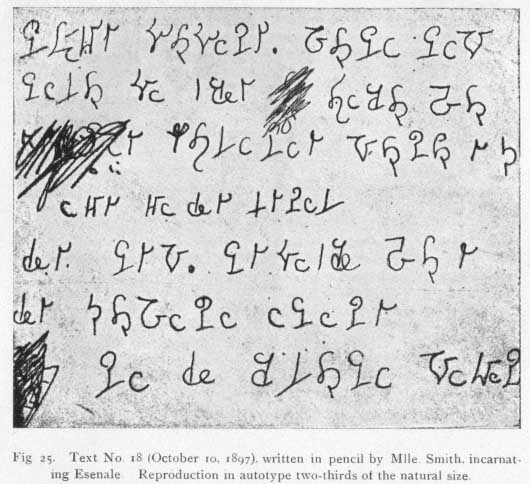
Fig 25. Text No. 18 (October 20, 1897). written in pencil by Mlle Smith, incarnating Esenale Reproduction in autotype two-thirds of the natural size. |
|
Fig. 26. Text No. 26 (August 21, 1898), which appeared in visual hallucination, and was copied by Mlle. Smith. Reproductions in autotype. |
this text was intended for Mme. Mirbel, who was then in the country, but to whom the person very clearly indicated by the final characteristic was about to pay a visit and could carry the message.) I then offer Hélène a pencil in the hope of obtaining this same text in writing; after various tergiversations and grimaces, denoting a state of increasing somnambulism, she finally takes the pencil between her index and middle fingers, tells Esenale that she still sees him and makes him sit down by her side, and then begins to write, completely absent and fascinated by the paper. The left index-finger (Leopold) informs us that it is Esenale himself who is writing by means of Hélène's arm. Twice she interrupts herself in order to say to Esenale, "Oh! do not go yet, stay a little while longer!" She appears nervous and agitated, and often stops writing to stab her paper with her pencil or to make erasures or scribble on it (see Fig. 25); in the zé of the last line, she forgets the é (this did not prevent Esenale from pronouncing the word correctly at the time of its translation).
|
* 19. |
m [en] |
cé |
kié |
mache |
di |
triné |
sandiné |
téri |
|
|
|
(Amie, |
je |
ne |
puis |
te |
parler |
longtemps |
comme |
|
|
|
né |
êzi |
vraïni |
zou |
réch |
mirâ |
milé |
piri |
mirâ |
|
|
est |
mon |
désir; |
plus |
tard, |
adieu |
|
|
adieu.) |
(Friend, I cannot speak to thee a long time, as is my desire; later, farewell, farewell!)
Graphic, then Auditive. October 24, 1897 (there has never been any translation of this text, two words of which are still unknown).—Hélène first sees the table illumined by a green light in which
some designs appear which she copies, and which give this text, except the two last letters of the first word, the place of which remains blank. Immediately after she hears Martian spoken, which she repeats. It is the same text; then she has a vision of Astané, Esenale, and a little girl whose name she hears as Niké; but this soon gives way to other non-Martian somnambulisms. (See Fig. 25.)
|
* 20. |
Siké |
évaï |
diviné |
zé |
niké |
crizi |
capri |
né |
amé |
|
|
|
|
|
Siké, |
sois |
heureux! |
Le |
petit |
oiseau |
noir |
est |
venu |
|
|
|
|
|
orié |
antéch |
é |
êzé |
carimi |
ni |
êzi |
érié |
é |
nié |
pavinée |
hed |
|
|
frapper |
hier |
à |
ma |
fenêtre, |
et |
mon |
âme |
a |
été |
joyeuse; |
il |
|
|
lé |
sadri |
dé |
zé |
véchir |
tiziné |
Matêmi |
misaïmé |
kâ |
lé |
|
|
|
|
me |
chanta: |
tu |
le |
verras |
demain.— |
Matêmi, |
fleur |
qui |
me |
|
|
|
|
amèz |
essaté |
Arvâ |
ti |
éziné |
udâniξ |
amès |
tès |
uri |
amès |
|
|
|
|
fais |
vivre, |
soleil |
de |
mes |
songes, |
viens |
ce |
soir, |
viens |
|
|
|
|
sandiné |
ten |
ti |
si |
évaï |
divinée |
|
Romé |
va |
né |
Siké |
|
|
|
longtemps |
près |
de |
moi; |
sois |
heureuse! |
— |
Romé, |
où |
est |
Siké?— |
|
|
|
atrizi |
ten |
té |
taméch |
épizi |
|
|
|
|
|
|
|
|
|
Là-bas, |
près |
du |
"taméche" |
rose. |
|
|
|
|
|
|
|
Siké, be happy! The little black bird came yesterday rapping at my window, and my soul was joyful; he sang to me: Thou wilt see him to-morrow. Matêmi, flower which makes me live, sun of my dreams, come this evening; come for a long time to me; be happy!—Romé, where is Siké?—Yonder, near the "taméche" rose.
Auditive, then Graphic. November 28, 1897 (translated same seance).—Fragments of conversation heard during the vision of the Martian fête described on p. 185. Siké (a young man) and Matêmi (a young girl) form the first couple who pass by and walk off in the direction of a large bush with red flowers (tamèche); then a second couple exchange the last words of the text while going to rejoin the
first. After this vision, which she contemplated standing and described with much animation, Hélène seated herself and began to write the same Martian phrases. It is ascertained from Leopold that it was Astané who held her hand (in holding the pencil between the thumb and the index-finger—that is, after the manner of Leopold and not that of Hélène as she had held it in writing text No. 17). The writing being finished, Leopold directs that Hélène shall be made to seat herself on the couch for the scene of translation.
|
21. |
véchêsi |
têsée |
polluni |
avé |
métiche |
é |
vi |
ti |
|
|
Voyons |
cette |
question, |
vieux |
homme; |
à |
toi |
de |
|
|
bounié |
seïmiré |
ni |
triné |
|
|
|
|
|
|
chercher, |
comprendre |
et |
parler. |
|
|
|
|
Now this question, old man; it is for thee to seek, to understand and speak.
Auditive. January 15, 1898 (translated February 13).—Fragment of conversation between two Martian personages seen in a waking vision.
|
22. |
astané |
cé |
amès |
é |
vi |
chée |
brimi |
messé |
téri |
|
|
Astané, |
je |
viens |
â |
toi; |
ta |
sagesse |
grande |
comme |
|
|
ché |
pocrimé |
lé. . . |
|
|
|
|
|
|
|
|
ton |
savoir |
me. . . |
|
|
|
|
|
|
Astané, I come to thee; thy great wisdom as well as thy knowledge to me. . .
Auditive. About January 25, 1898 (translated February 13).—Vision, at six o'clock in the morning, of a young Martian girl (Matêmi?) traversing a tunnel through a mountain and arriving at the house of Astané, to whom she addresses this utterance, followed by many others which Hélène could not grasp with sufficient distinctness to note them down.
|
23. |
[A] |
paniné |
évaï |
kirimé |
zé |
miza |
ami |
grini |
|
|
|
|
|
|
Panine, |
sois |
prudent, |
le |
"miza" |
va |
soulever; |
|
|
|
|
|
ké |
chée |
éméche |
rès |
pazé— |
[B] |
pouzé |
tès |
luné |
soumini |
|
|
|
que |
ta |
main |
se |
retire!— |
|
Pouzé, |
ce |
jour |
riant. . . |
|
|
|
arvâ |
ii |
cen |
zé |
primi |
ti |
ché |
chiré |
kiz |
pavi |
luné— |
|
|
Arva |
si |
beau. . . |
le |
revoir |
de |
ton |
fils. . . |
quel |
heureux |
jour— |
|
|
[C] |
saïné |
êzi |
chiré |
izé |
linéï |
kizé |
pavi |
êzi |
mané |
|
|
|
|
Saïné, |
mon |
fils, |
enfin |
debout! |
quelle |
joie!. . . |
Mon |
père |
|
|
|
ni |
êzé |
modé |
tiziné |
êzi |
chiré |
êzi |
mané |
cé |
êvé |
adi |
|
|
et |
ma |
mère. . . |
Demain, |
mon |
fils. . . |
Mon |
père, |
je |
suis |
bien |
|
|
anâ |
|
|
|
|
|
|
|
|
|
|
|
|
maintenant. |
|
|
|
|
|
|
|
|
|
|
Paniné, be prudent, the "miza" is about to arise; remove thy hand! Pouzé, this laughing day. . . Arva so beautiful. . . The return of thy son. . . What happy day—Saïné, my son, finally standing! What joy!. . . My father and my mother. . . To-morrow, my son. . . my father, I am well now.
Auditive. February 20, 1.898 (translated same seance).—Very complicated Martian vision. First, three small, movable houses, like pavilions or Chinese kiosks, going about on little balls; in one of these, two unknown personages, one of whom puts her hand out of a small oval window, which occasions, on the part of her companion, the observation of the first sentence (A) of the text; at this instant, in fact, these rolling pavilions (miza) assume an oscillatory movement, which makes a noise like "tick-tack," and then glide like a train upon rails. They go around a high red mountain and come into a sort of magnificent gorge or ravine, with slopes covered with extraordinary plants, and where they find white houses on an iron framework resembling piles. The two men then alight from their "miza," chatting together, but Hélène can only hear
fragments (B) of their conversation. A young man of sixteen to eighteen years of age comes to meet them, who has his head tied up in a kind of nightcap, and having no hair on the left side. Martian salutations are exchanged; they mutually strike their heads with their hands, etc. Hélène complains of hearing very confusedly that which they are saying, and can only repeat ends of sentences (C). She has pain in her heart, and Leopold dictates to me by the left index-finger, "Put her to sleep," which presently leads to the customary scene of translation of the text.
|
24. |
saïné |
êzi |
chiré |
iée |
êzé |
pavi |
ché |
vinâ |
ine |
ruzzi |
|
|
Saïné, |
mon |
fils, |
toute |
ma |
joie, |
ton |
retour |
au |
milieu |
|
|
ti |
nini |
né |
mis |
mess |
assilé |
atimi. . . |
itéche. . . |
|
|
|
|
de |
nous |
est |
un |
grand, |
immense |
bonheur. . . |
toujours. . . |
|
|
|
|
furimir. . . |
nori |
|
|
|
|
|
|
|
|
|
|
aimera. . . |
jamais. |
|
|
|
|
|
|
|
|
Saïné, my son, all my joy; thy return to our circle is a great, an immense happiness. . . always will love. . . ever.
Auditive. March 11, 1898 (translated August 21).—"Yesterday morning, on jumping out of bed," wrote Hélène to me, when sending me this text, "I had a vision of Mars, almost the same as that which I had before (at the seance of February 20). I saw again the rolling pavilions, the houses on piling, several personages, among them a young man who had no hair on one side of his head. I was able to note some words. It was very confused, and the last words were caught on the wing, when here and there something a little clear came to me . . ."
|
25. |
dé |
véchi |
ké |
ti |
éfi |
mervé |
éni |
|
|
Tu |
vois |
que |
de |
choses |
superbes |
ici. |
Thou seest what superb things (are) here.
Auditive. August 21, 1898 (translated same seance).—Waking vision of a river between two rose-colored mountains, with a bridge (like that in Fig. 9) which lowered itself into the water and disappeared in order to allow five or six boats to pass (like that in Fig. 13), then reappeared and was restored to its place. As Hélène describes all this, she hears a voice speaking to her the above Martian words of the text.
|
* 26. |
Astané |
né |
zé |
ten |
ti |
vi |
|
|
Astané |
est |
là |
près |
de |
toi. |
Astané is there, near to thee.
Visual. August 21, 1898 (translated same seance).—Following the preceding scene: Hélène perceives "in the air" (illumined and red—that of her Martian vision) some characters unknown to her, which she copies (see Fig. 26). I ask her, showing her the word zé (which elsewhere always stands for le), if she is not mistaken. She verifies it by comparing it with the imaginary model before her and affirms it to be correct.
|
27. |
siké |
kiz |
crizi |
hantiné |
hed |
é |
ébrinié |
rès |
amêré |
é |
|
|
|
|
|
Siké, |
quel |
oiseau |
fidèle! |
il |
a |
pensé |
se |
réunir |
à |
|
|
|
|
|
nini |
éssaté |
ti |
iche |
atimi |
|
matêmi |
hantiné |
hed |
né |
|
|
|
|
|
nous, |
vivre |
de |
notre |
bonheur! |
— |
Matêmi |
fidèle, |
il |
est |
|
|
|
|
|
hantiné |
êzi |
darié |
|
siké |
tès |
ousti |
ké |
zé |
badêni |
lassuné |
|
|
|
|
fidèle |
mon |
cœur! |
— |
Siké, |
ce |
bateau |
que |
le |
vent |
approche |
|
|
|
|
mazi |
trimazi |
hed |
é |
ti |
zi |
mazêté |
é |
poviné |
é |
nini |
zé |
priâni |
|
|
avec |
force! |
il |
a |
de |
la |
peine |
à |
arriver |
à |
nous; |
le |
flot |
|
|
é |
fouminé |
ivraïni |
idé |
é |
ti |
zi |
mazêté |
é |
vizêné |
zé |
|
|
|
|
est |
puissant |
aujourd’hui; |
on |
a |
de |
la |
peine |
à |
distinguer |
le |
|
|
|
|
chodé |
|
|
|
|
|
|
|
|
|
|
|
|
|
|
"chodé." |
|
|
|
|
|
|
|
|
|
|
|
|
|
Fig. 27. Text No. 28 (October 8, 1898), written by Mlle. Smith, copying a text of Matêmi, seen in a visual hallucination. [The slight tremor of some of the lines is not in the original, but occurred in the copying of the text in the ink, which was written in pencil and too pale for reproduction.] |
Siké, what (a) faithful bird! he has thought to reunite himself to us, to live of our happiness!—Matêmi faithful, my heart is faithful!—Siké, this boat which the wind brings near with force! it has some difficulty in reaching us; the current is strong to-day; one has some difficulty in distinguishing the "chodé."
Auditive. About the 4th of September, 1898 (translated October 16).—Hélène heard and noted this phrase at the same time at which she had the vision of the two young Martian people who were walking in a kind of flower-garden, and saw a boat arrive, like that in Fig. 13. The meaning of chodé has not been ascertained.
|
* 28. |
men |
mess |
Astané |
cé |
amès |
é |
vi |
itéch |
li |
tès |
|
|
|
|
Ami |
grand |
Astané, |
je |
viens |
à |
toi |
toujours |
par |
cet |
|
|
|
|
alizé |
néümi |
assilé |
kâ |
ianiné |
êzi |
atèv |
ni |
lé |
|
|
|
|
|
élément |
mystérieux, |
immense, |
qui |
enveloppe |
mon |
étre |
et |
me |
|
|
|
|
|
tazié |
é |
vi |
med |
iéeξ |
éziné |
rabriξ |
ni |
tibraξ. |
men |
amès |
di |
|
|
lance |
à |
toi |
pour |
toutes |
mes |
pensées |
et |
besoins. |
Ami, |
viens |
te |
|
|
ouradé |
ké |
Matêmi |
uzénir |
chée |
kida |
ni |
ké |
chée |
brizi |
pi |
|
|
|
souvenir |
que |
Matêmi |
attendra |
ta |
faveur, |
et |
que |
ta |
sagesse |
lui |
|
|
|
dézanir. |
évaï |
diviné |
tès |
luné |
|
|
|
|
|
|
|
|
|
répondra. |
Sois |
heureux |
ce |
jour. |
|
|
|
|
|
|
|
Friend great Astané, I come to thee always by this element, mysterious, immense, which envelops my being and launches me to thee by all my thoughts and desires. Friend, come thou to remember that Matêmi will await thy favor, and that thy wisdom will answer him. Be happy to-day.
Visual. October 3, 1898 (translated October 16).—At a quarter before nine in the evening Mlle. Smith, desiring to obtain a communication from Leopold for herself and her mother, sat down in an easy-chair and gave herself up to meditation. Presently she hears the voice of Leopold telling her that he cannot manifest himself that evening, but that something much more interesting and important
is being made ready. The room seems to her to become completely obscured, except the end of the table at which she is sitting, which is illumined with a golden light. A young Martian girl in a yellow robe and with long tresses then comes and seats herself beside her and begins to trace, without ink or paper, but with a point on the end of her index-finger, black figures on a white cylinder, at first placed on the table, afterwards on her knees, and which is unrolled as she writes. Hélène is near enough to see the characters clearly, and copies them in pencil on a sheet of paper (see Fig. 27), after which the vision vanishes and her mother and the room reappear.
|
29. |
sazêni |
kiché |
nipunêzé |
dodé |
né |
pit |
léziré |
bèz |
|
|
|
Sazeni |
pourquoi |
craindre? |
Ceci |
est |
sans |
souffrance |
ni |
|
|
|
neura |
évaï |
dastrée |
firêzi |
zé |
bodri |
né |
dorimé |
zé |
|
|
danger, |
sois |
paisible; |
certainement |
le |
os |
est |
sain, |
le |
|
|
pastri |
tubré |
né |
tuxé |
|
|
|
|
|
|
|
sang |
seul |
est |
malade. |
|
|
|
|
|
Sazeni, why fear? This is without suffering or danger, be peaceful; certainly the flesh is well, the blood alone is ill.
Auditive. October 14, 1898 (translated October 16).—Morning vision of an unknown gentleman and lady, the latter having her arm, spotted with red, applied to an instrument with three tubes placed on a shelf fastened to the wall. These words were spoken by the man; the lady said nothing.
|
30. |
modé |
ké |
hed |
oné |
chandêné |
têsé |
mûné |
ten |
ti |
|
|
|
Mère, |
que |
ils |
sont |
délicieux |
ces |
moments |
près |
de |
|
|
|
vi |
bigâ |
va |
bindié |
idé |
ti |
zâmé |
tensée |
zou |
réche |
|
|
toi!— |
Enfant, |
où |
trouve |
on |
de |
meilleurs |
instants? |
plus |
tard |
|
|
med |
ché |
atèv |
kiz |
fouminé |
zati |
|
|
|
|
|
|
pour |
ton |
être |
quel |
puissant |
souvenir. |
|
|
|
|
Mother, how delightful they are, these moments near to thee!—Child, where finds one better moments? later for thy being what (a) powerful remembrance.
Auditive. October 22, 1898 (translated December 18).—"At a quarter-past six in the morning; vision of a pebbly shore; earth of a red tint; immense sheet of water, of a bluish green. Two women are walking side by side. This was all I could gather of their conversation."
Click to enlarge
Fig. 28. Text No. 31 (October 27, 1898), written by Mlle. Smith, incarnating Ramié. Natural size.
|
* 31. |
Râmié |
bisti |
ti |
Espênié |
ché |
dimé |
ûni |
zi |
|
|
|
|
|
Ramié |
habitant |
de |
Espênié, |
ton |
semblable |
par |
la |
|
|
|
|
|
trimazi |
tié |
vadâzâξ |
di |
anizié |
bana |
mirâξ. |
Ramié |
di |
|
|
|
|
force |
des |
"vadazas," |
te |
envoie |
trois |
adieux. |
Ramié, |
te |
|
|
|
|
trinir |
tié |
toumaξ |
ti |
bé |
animinâ |
ni |
tiche |
di |
uzir |
nâmi |
|
|
parlera |
des |
charmes |
de |
sa |
existence |
et |
bientôt |
te |
dira |
beaucoup |
|
|
ti |
Espênié. |
évaï |
divinée |
|
|
|
|
|
|
|
|
|
de |
Espênié |
Sois |
heureuse! |
|
|
|
|
|
|
|
Ramié, dweller in Espénié, thy like, by the force of the " vadazas," sends thee three adieux. Ramié will speak to thee of the charms of his existence, and presently will tell thee much of Espénié. Be happy!
Graphic. October 27, 1898 (translated December 18).—"Ten minutes to one in the afternoon. No
vision, but a severe cramp in the right arm and a strong impulse to take pencil and paper. I write, I know not why." (It is seen by the translation given two months later that the text refers to the first manifestation of Ramié and is an announcement of the ultra-Martian vision which came a few days later.) See Fig. 28. The term vadazas, which has never been explained, has not a Martian appearance, and appears to have been borrowed from the Hindoo cycle. As to Espénié, see text No. 6.
|
32. |
anâ |
évaï |
maniké |
é |
bétiné |
mis |
tié |
attanâ |
|
|
|
|
Maintenant |
sois |
attentive |
à |
regarder |
un |
des |
mondes |
|
|
|
|
kâ |
di |
médinié |
bétinié |
tès |
tapié |
ni |
bée |
atèv |
kavivé |
|
|
qui |
te |
entourent. |
Regarde |
ce |
"tapié" |
et |
ses |
êtres |
étranges. |
|
|
danda |
anâ |
|
|
|
|
|
|
|
|
|
|
Silence |
maintenant! |
|
|
|
|
|
|
|
|
Now be attentive to behold one of the worlds which surround thee. Look at that " tapié" and its strange beings. Silence now!
Auditive. November 2, 1898 (translated December 18).—Hélène has a morning vision of a Martian (Ramié) who encircles her waist with one arm and with the other shows her, while speaking these words, a strange tableau (tapié) containing extraordinary beings speaking the unknown language of the following text. At the moment the vision is effaced Hélène writes, without perceiving that she has done so, text No. 34. (For further details, see the following chapter on the Ultra-Martian.)
|
33. |
bak |
sanak |
top |
anok |
sik |
|
|
|
|
|
|
sirima |
nêbé |
viniâ-ti-mis-métiche |
ivré |
toué |
|
|
|
|
|
|
rameau |
vert |
nom |
de |
un |
homme |
sacré |
dans p. 234 |
|
|
|
étip |
vané |
sanim |
batam |
issem |
tanak |
|
|
|
|
|
viniâ-ti-misé-bigâ |
azâni |
maprinié |
imizi |
kramâ |
ziné |
|
|
|
|
|
nom de une enfant |
mal |
entré |
sous |
panier |
bleu |
|
|
|
|
|
vanem |
sébim |
mazak |
tatak |
sakam |
|
|
|
|
|
|
viniâ-ti-mis-zaki |
datrinié |
tuzé |
vâmé |
gâmié |
|
|
|
|
|
|
nom de un animal |
caché |
malade |
triste |
pleure. |
|
|
|
|
Branch green—name of a man—sacred—in—name of a child—bad—entered—under—basket—blue—name of an animal—hidden—ill—sad—weeps.
Auditive, as to the non-Martian text (see following chapter) which Hélène heard spoken on the 2d of November by the strange beings of the tableau of the preceding vision. Vocal, as to the Martian translation of this text, which was given by Astané (incarnated in Hélène and speaking the unknown language by her mouth, followed by its Martian equivalent
|
Fig. 29. Text No. 34 (November 2, 1898), written by Mlle. Smith, incarnating Ramié. Natural size. |
for each word), in the seance of the 18th of December, 1898. Immediately after, Astané yielded his place to Esenale, who in turn repeated the Martian phrase, translating it word for word into French by the customary process.
|
* 34. |
Ramié |
di |
pédrinié |
anâ |
né |
ériné |
diviné |
|
|
|
|
|
|
Ramié |
te |
quitte |
maintenant, |
est |
satisfait, |
heureux p. 235 |
|
|
|
|
|
|
té |
mûné |
ten |
ti |
vi. |
hed |
dassinié |
mis |
abadâ |
ti |
ché |
|
|
du |
moment |
près |
de |
toi. |
Il |
garde |
un |
pelt |
de |
ton |
|
|
atèv |
ni |
di |
parêzié |
banâ |
mirâξ. |
— |
évaï |
divinée |
|
|
|
|
être |
et |
te |
laisse |
trois |
adieux. |
|
Sois |
heureuse! |
|
|
Ramié leaves thee now, is satisfied, happy for the moment near to thee. He retains a little of thy being and leaves thee three adieux. Be happy.
Graphic. November 2, 1898 (translated December 18).—Hélène only perceived after its accomplishment that her hand, which she felt "firmly held," had written this text at the close of the preceding vision (see Fig. 29).
|
35. |
[A] |
attanâ |
zabiné |
pi |
ten |
té |
iche |
tarvini |
mabûré |
|
|
|
|
Monde |
arriéré, |
très |
près |
du |
nôtre, |
langage |
grossier, |
|
|
|
nubé |
téri |
zée |
atèv |
[B] |
Astané |
êzi |
dabé |
fouminé |
ni |
|
|
curieux |
comme |
les |
être!— |
|
Astané, |
mon |
maître |
puissant |
et |
|
|
ié |
ti |
takâ |
tubré |
né |
bibé |
ti |
zé |
umêzé |
|
|
|
tout |
de |
pouvoir, |
seul |
est |
capable |
de |
le |
faire. |
|
Hidden world, very near to ours, coarse language, curious like the beings.—Astané, my powerful master and all powerful, alone is capable of doing it.
Auditive. December 5, 1898 (translated December 18).—Working by lamp-light at seven o'clock in the morning, Hélène again had a vision of the Martian (Ramié) who had clasped her waist with one arm while showing her something with a gesture of the other (probably the tableau of the preceding vision, though Hélène did not see it) and uttering the first phrase of it (A). The second phrase (B) is the reply of this same Martian to a mental question of Hélène asking him to translate the strange language of the other day. (She trust, therefore, have understood the meaning of the first phrase in order to have replied to it by her appropriate mental question.)
|
Fig. 30. Text No. 37 (March 24, 1899), written by Mlle. Smith, incarnating Astané. [Collection of M. Lemaître.] Owing to a defect of the stereotype plate a dot is lacking on the first letter. |
|
36. |
[A] |
aé |
aé |
aé |
aé |
lassunié |
lâmi |
rêzé |
aé |
aé |
aé |
|
|
|
Aé, |
aé, |
aé, |
aé!— |
Approche; |
voici |
Rêzé. . . |
aé, |
aé, |
aé, |
|
|
aé |
niké |
bulié |
va |
né |
ozâmié |
zitêni |
primêni—[B] |
ozâmié |
|
|
|
|
aé, |
petit |
Bulié. . . |
où |
est |
Ozamié? |
Zitêni, |
Primêni. . . |
Ozamié, |
|
|
|
|
viniâ |
ti |
mis |
bigâ |
kêmâ |
zitêni |
viniâ |
ti |
misé |
bigâ |
kêmisi |
|
|
nom |
de |
un |
enfant |
mâle; |
Zitêni, |
nom |
de |
une |
enfant |
femelle; |
|
|
primêni |
viniâ |
ti |
misé |
bigâ |
kêmisi |
|
|
|
|
|
|
|
Priméni, |
nom |
de |
une |
enfant |
femelle. |
|
|
|
|
|
Aé, aé, aé, aé! Approach, here is Rézá, aé, aé, aé, aé, little Bulié. . . where is Ozamié? Zitêni, Primêni. . . Ozamié, name of a male child; Zitêni, name of a female child; Primêni, name of a female child.
Auditive. March 8, 1899 (translated June 4).—Hélène heard the phrase (A) during the vision of which the description follows. At the translation, as the sitters did not at once understand that the three first words are proper names, Esenale adds the phrase (B) with its French signification. "I was unable to go to sleep yesterday evening. At half-past eleven everything around me was suddenly lighted up, and the vivid light permitted me to distinguish surrounding
objects. I arose this morning with a very clear remembrance of that which I then saw. A tableau was formed in that light, and I had more before me than the interior of a Martian house—an immense square hall, around which shelves were fastened, or rather little tables suspended and fastened to the wall. Each of these tables contained a baby, but not at all bundled up; all the movements of these little infants were free, and a simple linen cloth was thrown round the body. They might
|
Fig. 31. Text No. 38 (March 30, 1899), written by Mlle. Smith copying a text of Ramié, who appeared to her in a visual hallucination. [Collection of M. Lemaître.] |
be said to be lying on yellow moss. I could not say with what the tables were covered. Some men with strange beasts were circulating round the hall; these beasts had large flat heads, almost without hair, and large, very soft eyes, like those of seals; their bodies, slightly hairy, resembled somewhat those of roes in our country, except for their large and flat tails; they had large udders, to which the men present fitted a square instrument with a tube, which was offered to each infant, who was thus fed
with the milk of these beasts. I heard cries, a great hurly-burly, and it was with difficulty that I could note these few words [of this text]. This vision lasted about a quarter of an hour; then everything gradually disappeared, and in a minute after I was in a sound sleep."
|
* 37. |
Astané |
bounié |
zé |
buzi |
ti |
di |
triné |
nâmi |
ni |
|
|
Astané |
cherche |
le |
moyen |
de |
to |
parler |
beaucoup |
et |
|
|
ti |
di |
umêzé |
séïmiré |
bi |
tarvini |
|
|
|
|
|
de |
to |
faire |
comprendre |
son |
langage. |
|
|
|
Astané searches for the means to speak to thee much and to make thee understand his language.
Graphic. March 24, 1899 (translated June 4). "Half-past six in the morning. Vision of Astané. I was standing, about to put on my slippers. He spoke to me, but I could not understand him. I took this sheet of paper and a pencil; he spoke to me no more, but seized my hand which held the pencil. I wrote under this pressure; I understood nothing, for this is as Hebrew to me. My hand was released; I raised my head to see Astané, but he had disappeared" (see Fig. 30).
|
* 38. |
fédié |
amès |
Ramié |
di |
uzénir |
tès |
luné |
amès |
zé |
|
|
Fédié, |
viens; |
Ramié |
te |
attendra |
ce |
jour; |
viens, |
le |
|
|
boua |
trinir |
|
|
|
|
|
|
|
|
|
frère |
parlera. |
|
|
|
|
|
|
|
Fédié, come; Ramié will await thee to-day; come, the brother will speak.
Visual. March 30, 1899 (translated June 4).—Seated at her toilet-table, at half-past nine o'clock in the evening, Hélène found herself suddenly enveloped in a rose-colored fog, which hid one part of the furniture from her, then was dissipated, allowing
her to see, at the farther end of her room, "a strange hall, lighted with rose-colored globes fastened to the wall." Nearer to her appeared a table suspended in the air, and a man in Martian costume, who wrote with a kind of nail fastened to his right index-finger. "I lean towards this man; I wish to place my left hand on this imaginary table, but my hand falls into empty space, and I have great difficulty in restoring it to its normal position. It was stiff, and for some moments felt very weak." Happily the idea occurred to her to take pencil and paper and copy "the characters which the Martian, whom I had seen several times before [Ramié], traced; and with extreme difficulty—since they were much smaller than mine—I succeeded in reproducing them" (the Martian text of Fig. 31). All this lasted about a quarter of an hour. I went immediately to bed, and saw nothing more that evening, nor on the following day."
|
Fig. 32. Text No. 39 (April x, 1899), written by Mlle. Smith, incarnating Ramie. [Collection of M. Lemaître.] Natural size. |
|
* 39. |
Ramié |
pondé |
acâmi |
andélir |
téri |
antéch |
|
|
|
|
|
|
|
Ramié, |
savant |
astronome, |
apparaîtra |
comme |
hier |
|
|
|
|
|
|
|
iri |
é |
vi |
anâ. |
riz |
vi |
banâ |
mirâξ |
ti |
Ramié |
ni |
|
|
souvent |
à |
toi |
maintenant. |
Sur |
toi |
trois |
adieux |
de |
Ramié |
et |
|
|
Astané. |
évaï |
divinée |
|
|
|
|
|
|
|
|
|
|
Astané. |
Sois |
heureuse! |
|
|
|
|
|
|
|
|
Ramié, learned astronomer, will appear as yesterday often to thee now. Upon thee three adieux from Ramie and Astané. Be happy*!
Graphic. April 1, 1899 (translated June 4).—"Again, on going to bed at five minutes past ten, a new vision of the personage seen day before yesterday [Ramié]. I thought he was about to speak, but no sound issued from his lips. I quickly take pencil and paper, and feel my right arm seized by him, and I begin to trace the strange handwriting attached hereto (see Fig. 32). He is very affectionate; his bearing, his look, everything breathes both goodness and strangeness. He leaves me really charmed."
|
40. |
ramié |
ébanâ |
dizênâ |
zivênié |
ni |
bi |
vraïni |
|
|
|
|
|
|
Ramié, |
lentement, |
profondément, |
étudie, |
et |
son |
désir |
|
|
|
|
|
|
assilé |
né |
ten |
ti |
rès |
kalâmé |
astané |
êzi |
dabé |
né |
zi |
|
|
immense |
est |
près |
de |
se |
accomplir. |
Astané |
mon |
maítre |
est |
là |
|
|
med |
lé |
godané |
ni |
ankôné |
évaï |
bané |
zizazi |
divinée |
|
|
|
|
pour |
me |
aider |
et |
réjouir. |
Sois |
trois |
fois |
heureuse! |
|
|
Ramié, slowly, deeply studies, and his great desire is near to being accomplished. Astané, my master, is there to aid me and to rejoice. Mayst thou be thrice happy!
Auditive. June 4, 1899 (translated same seance).Hemisomnambulism, in which Hélène, without having a vision, hears a voice addressing words to her, from which, with some difficulty, she collected the preceding sentences.
41. To these texts, forming sentences, in order to complete the whole, some isolated words must be added, gathered on various occasions, the meaning of which is obtained with sufficient certainty, either from the French context in which they were framed,
or from Hélène's description of the objects which they designated These words are chèke, papier ("paper"); chinit, bague ("ring"); asnète, espèce de paravent ("kind of screen"). Anini Nikaîné, proper name of a little girl (see p. 176), probably the Martian sister of Esenale, who floats beside her, invisible to her, and watches over her during an illness, after the fashion of spirit protectors. Béniel, proper name of our earth, as seen from Mars (which is called Durée in texts 7 and 9).
Provided the reader has given some attention to the foregoing texts, if only to the two first, he undoubtedly will have been easily satisfied as to the pretended language of the planet Mars, and perhaps will be astonished that I have spent so much time upon it. But, as many of the habitués of the seances of Mlle. Smith—and, naturally, Mlle. Smith herself—hold seriously to its authenticity, I cannot absolve myself from stating why the "Martian" is, in my opinion, only an infantile travesty of French. Even in default of the astronomical importance which is claimed for it on the authority of Leopold, this idiom preserves all the psychological interest which attaches to automatic products of subconscious activities of the mind, and it well deserves some minutes of examination.
It is necessary at the start to render this justice to the Martian (I continue to designate it by that name, for the sake of convenience)—namely, that it is, indeed,
a language and not a simple jargon or gibberish of vocal noises produced at the hazard of the moment without any stability. It cannot be denied the following characteristics—First: It is a harmony of clearly articulated sounds, grouped so as to form words. Secondly: These words when pronounced express definite ideas. Thirdly, and finally: Connection of the words with the ideas is continuous; or, to put it differently, the signification of the Martian terms is permanent and is maintained (apart from slight inconsistencies, to which I will return later on) from one end to the other of the texts which have been collected in the course of these three years. * I will add that in speaking fluently and somewhat quickly, as Hélène sometimes does in somnambulism (texts 4, 11, 15, etc.), it has an acoustic quality altogether its own, due to the predominance of certain sounds, and has a peculiar intonation difficult to describe. Just as one distinguishes by ear foreign languages which one does not understand, the whole dialect possessing a peculiar accent which causes it to be recognized, so in this case one perceives, from the first syllables uttered,
whether Hélène is speaking Hindoo or Martian, according to the musical connection, the rhythm, the choice of consonants and vowels belonging to each of the two idioms. In this the Martian, indeed, bears the stamp of a natural language. It is not the result of a purely intellectual calculation, but influences of an æsthetic order, emotional factors, have combined in its creation and instinctively directed the choice of its assonances and favorite terminations. The Martian language has certainly not been fabricated in cold blood during the normal, habitual, French (so to speak) state of Mlle. Smith, but it bears in its characteristic tonalities the imprint of a peculiar emotional disposition, of a fixed humor or psychical Orientation, of a special condition of mind, which may be called, in one word, the Martian state of Hélène. The secondary personality, which takes pleasure in linguistic games, seems, indeed, to be the same, at its source, as that which delights in the exotic and highly colored visual images of the planet of red rocks, and which animates the personages of the Martian romance.
A glance at the ensemble of the foregoing texts shows that Martian, as compared with French, is characterized by a superabundance of é, ê, and i’s, and a scarcity of diphthongs and the nasal sounds. A more accurate statistical table of sounded vowels which strike the ear in reading aloud the Martian texts on the one hand, and their translation into French on the other, gives me the percentages of Table I., which follows. But it is well known that the vowels are distinguished, from the acoustic point
of view, by certain fixed characteristic sounds, and that they are distributed at different heights in the musical scale.
|
|
|
Martian |
French |
|
a |
% |
16.3 |
13.7 |
|
e mute (like those of casemate) |
“ |
3.6 |
20.8 |
|
e closed or half-closed (like those of hébété, rêvé) |
“ |
36.9 |
14.3 |
|
e open (like that of aloès) |
“ |
2.1 |
4.6 |
|
i |
“ |
34.3 |
13.4 |
|
o |
“ |
2.3 |
5.7 |
|
u |
“ |
2.3 |
3.1 |
|
Diphthongs and nasals (ou, oi, eu, an, in, on, un) |
“ |
2.1 |
24.5 |
|
|
|
Martian |
French |
|
Vowels, high (i and e sounded) |
% |
73.3 |
32.3 |
|
Vowels, middle (a and o) |
“ |
18.6 |
19.4 |
|
Vowels, low or hollow (u; diphthongs and nasals; e mute) |
“ |
8.0 |
48.4 |
[paragraph continues] i and é are the highest, a and o occupy the middle place, u and ou are found in the lower part of the scale. In adding to the latter, therefore, the nasals, which are always hollow, and also e mute, Table I. divides itself into the three groups of Table II. from the point of view of height and sonorousness. It is, therefore, clear that the Martian is of a general tonality much higher than the French; since, while the two languages have almost the same proportion of middle vowels, the low, hollow, or mute sounds, which constitute almost one-half of the French vowels, amount to scarcely one-twelfth in Martian,
in which the high sounds, on the contrary, represent in bulk three-quarters of the vowels, against one-third only in the French. On the other hand, researches in the field of colored audition have demonstrated that a close psychological connection exists, based on certain emotional analogies and an equivalence of organic reactions, between the high sounds and the bright or vivid colors, and the low or hollow sounds and the sombre colors. But this same correlation is found in the somnambulistic life of Mlle. Smith, between the brilliant, luminous, highly colored visions which characterize her Martian cycle and the language of the high and sonorous vowels which gushes forth in the same cycle. It is allowable to conclude from this that it is really the same emotional atmosphere which bathes and envelops these varied psychological products, the same personality which gives birth to these visual and phonetic automatisms. The imagination cannot, however, as is easily understood, create its fiction out of nothing; it is obliged to borrow its materials from individual experience. The Martian tableaux are, therefore, only a reflection. of the terrestrial world, but of that part of it which possesses the most warmth and brilliancy—the Orient; in the same way, the Martian language is only French metamorphosed and carried to a higher diapason.
I admit, then, that Martian is a language, and a natural language, in the sense that it is automatically brought forth in the emotional state, or by the secondary personality, which is the source of all the remainder of the cycle without the conscious participation
of Mlle. Smith. It remains for me now to mention some of the characteristics which seem to indicate that the inventor of this subliminal linguistic work had never known any idiom other than French, that it is much more sensible to verbal expression than to logical connection of ideas, and that it possesses in an eminent degree that infantile and puerile character which I have already pointed out in the author of the Martian romance. It now becomes necessary to examine rapidly this unknown language, from the point of view of its phonetics and its writing, its grammatical form, its syntax, and its vocabulary.
1. Martian Phonetics and Handwriting.—Martian is composed of articulate sounds, all of which, consonants as well as vowels, exist in French. While on this globe languages geographically our neighbors (not to mention those farther away) differ each from the other by certain special sounds—ch, German, th, English, etc.—the language of the planet Mars does not permit of similar phonetic originalities. It seems, on the contrary, poorer in this respect than the French. As yet I have not found in it the hissing j or ge (as in juger), nor the double sound x. Martian phonetics, in a word, are only an incomplete reproduction of French phonetics.
The Martian alphabet, compared with ours, suggests a remarkable analogy. The graphic form of the characters is certainly novel, and no one would divine our letters in these designs of exotic aspect. Nevertheless, each Martian sign (with the single exception of that of the plural) corresponds to a
[paragraph continues] French sign, although the inverse is not the case, which indicates that here again we are in the presence of a feeble imitation of our system of handwriting.
The twelve written texts upon which I base my comparison comprise about 300 words (of which 160 are different) and 1200 signs. There are altogether twenty-one different letters, all of which have their exact equivalents in the French alphabet, which also has five others which Martian lacks; j and x, of which the sounds themselves have not been observed, and q, w, and y, of which there is a double use, with k, v, and i. This reduction of graphic material manifests itself in two other details. First, there are neither accents nor punctuation marks, with the exception of a certain sign, resembling the French circumflex, used sometimes in the shape of a point at the end of phrases. In the second place, each letter has only one form, the diversity of capitals and small letters not seeming to exist in Martian. Of ciphers we know nothing.
There are still three small peculiarities to notice:
1. In default of capitals, the initials of proper names are often distinguished by a point placed above the ordinary character.
2. In the case of double letters the second is replaced by a point situated at the right of the first.
3. Finally, there exists, in order to designate the plural of substantives and of some adjectives, a special graphic sign, answering to nothing in the pronunciation and having the form of a small vertical undulation, which reminds one a little of an amplification of
the French s, the usual mark of the plural in French. These peculiarities, outside the ordinary form of the letters, constitute the sum total of ingenuity displayed in Martian handwriting.
It must be added that this handwriting, which is not ordinarily inclined, goes from left to right, like the French. All the letters are of nearly the same height, except that the i is much smaller, and that they remain isolated from each other; their assembly into words and phrases offers to the eye a certain aspect of Oriental hieroglyphic inscriptions.
The Martian alphabet never having been revealed as such, we are ignorant of the order in which the letters follow each other. It would seem as though the letters had been invented by following the French alphabet, at least in great part, if one may judge according to the analogies of form of the Martian characters corresponding to certain series of French letters: compare a and b; g and h; s and t; and also the succession k, l, m, n.
It is in the phonetic value of the letters—that is to say, in the correspondence of the articulated sounds with the graphic signs—that the essentially French nature of the Martian may be seen. The only notable difference to be pointed out here between the two languages is the much greater simplicity of the Martian orthography, resulting in the employment of no useless letters. All are pronounced, even the final consonants, such as s, n, z, etc., which are generally silent in French. This gives the impression that the Martian handwriting is moulded on the spoken language, and is only the notation of the articulated sounds
of the latter by the most economical means. In so far it realizes the type of a handwriting truly phonetic—that is to say, where each sign corresponds to a certain elementary articulation, constant and invariable, and vice versa. It is full, on the other hand, of equivocations, of exceptions, of irregularities, which make one and the same letter to have very different pronunciations, according to circumstances, and, reciprocally, which causes the same sound to be written in different ways without our being able to perceive any rational explanation for all these ambiguities—were it not for the fact that the very same thing is to be found in French!
Martian is only disguised French. I will mention only the most curious and striking coincidences, all the more striking from the fact that the field from which I have collected them is very limited, being confined to the dozen texts written and pronounced, which contain only 160 different words.
The simple vowels of the Martian alphabet correspond exactly to the five French vowels, a, e, i, o, u, and have the same shades of pronunciation.
The Martian c plays the triple part which it also fulfils in French. The s has the same capricious character as in our language. It is generally hard, but between two vowels it becomes soft, like z.
2. Grammatical Forms.—The ensemble of the texts which we possess does not as yet permit us to make a Martian grammar. Certain indications, however, warrant the prediction that the rules of that grammar, if it ever sees the light of day, will be only the counterpart of, or a parody upon, those of French.
Here, for example, is a list of personal pronouns, articles, possessive adjectives, etc., which have appeared hitherto:
|
je cé |
me lé, moi si |
ton ché |
ce tès, ces têsé |
de ti |
|
tu dé |
te di, toi vi |
ta chée |
cette tés, têsée |
des tié |
|
il hed |
se rès, lui pi |
tes chi |
le (pron.) zé |
du té |
|
nous nini |
mon êzi |
son bi |
qui kâ, que ké |
au ine |
|
vous sini |
ma êzé |
sa bé |
quel kiz, quelle kizé |
|
|
ils hed |
mes éziné |
ses bée |
un mis, une misé |
|
|
on idé |
notre iche |
|
le, la, les (art.) zé, zi, zée. |
|
There are some texts where the feminine is derived from the masculine by the addition of an e mute, and the plural by the small, unpronounced sign, which has all the appearance of being a reminiscence of French s.
Between these two languages there is another order of points of contact, of a more special interest, because it shows the preponderating rôle which verbal images have often played in the making of Martian to the prejudice of the intrinsic, logical nature of the ideas. I should say that at all times the Martian translates the French word, allowing itself to be guided by auditive analogies without regard to the real meaning, in such a way that we are surprised to discover in the idiom of the planet Mars the same peculiarities of homonyms as in French. It is also the case that two vocables identical as to pronunciation, but of entirely heterogeneous signification, as the preposition à and the a of the verb avoir, are rendered in Martian by the same word, é.
Other curious coincidences are to be noted. In
[paragraph continues] French the conjunction et only slightly differs, from the point of view of phonic images, from the verb est; in Martian also there is a great analogy between ni and né, which translate these two words. Between the past participle nié of the verb to be and the conjunction ni there is only the difference of an é, just as between their French equivalents été and et.
It must be admitted that all these coincidences would be very extraordinary if they were purely fortuitous.
3. Construction and Syntax.—The order of the words is absolutely the same in Martian as in French. This identity of construction of phrases is pursued sometimes into the minutest details, such as the division or amputation of the negation ne . . . pas (texts 15 and 17), and also the introduction of a useless letter in Martian to correspond to a French euphemistic t (see text 15), Kèvi bérimir m hed, quand reviendra-t-il? ("when will he return?")
If it is admitted hypothetically that the succession of words, such as is given us in these texts, is not the natural ordering of the Martian language, but an artificial arrangement, like that of juxtalinear translations for the use of pupils, the very possibility of that correspondence absolutely word for word would remain an extraordinary fact without a parallel, since there is not a single language that I know of in which each term of the French phrase is always rendered by one term, neither more nor less, of the foreign phrase. The hypothesis referred to is, moreover, inadmissible, since the Martian texts, of which Esenale gives the literal translation, were not previously
arranged by him with that end in view; they are the identical words which Mlle. Smith heard and noted in her visions, often weeks and months before Esenale repeats them for the purpose of translating them, and which constitute the conversation, as such, taken from life, of the Martian personages. We must conclude from this that these in their elocution follow step by step and word by word the order of the French language, which amounts almost to saying that they speak a French the sounds of which have simply been changed.
4. Vocabulary.—From an etymological point of view, I have not been able to distinguish any rule of derivation, even partial, that would permit the suspicion that the Martian words had come from French words, according to some law. Apart from the entire first text, where it is difficult to deny that the people of Mars have stolen French terms of politeness, at the same time distorting them, no clear resemblance is to be seen between Martian words and the French equivalents; at most, there are traces of borrowing, like merve, superbe, which might have been abridged from merveille (text 25), and vechi, an imitation of voir.
Still less does the Martian lexicon betray the influence of other known languages (at least to my knowledge). A term which suggests such similarity is hardly ever met with—e.g., modé, mère ("mother"), and gudé bon ("good"), cause us to think of German or English words; animina ("existence") is like anima; various forms of the verbs être and vivre ("to be" and "to live"), êvé, évaï, essat, recall
the Latin esse or the Hebrew évé, and that passage of the Biblical story of the Creation where Eve is called the mother of all living beings. A linguist who happened to be at the same time a savant and a humorist would doubtless succeed in lengthening this list of etymologies, after the mode of the eighteenth century. But, cui bono? In that rarity of points of contact between the idioms of our terrestrial sphere and the Martian glossary, an argument might be found in favor of the extra-terrestrial origin of the latter, if, on the other hand, it did not seem to betray the influence of the French language from the fact that a notable proportion of its words reproduce in a suspicious manner the same number of syllables or letters as their French equivalents; note, for example, besides the terms of politeness already mentioned, the words tarvine, langage; haudan, maison; dodé, ceci; valini, visage, etc., and the great majority of the little words, such as cé, je; ké, que; ti, de; dé, tu; etc.
With the exception of such examples as these, it must be acknowledged that there is no trace of parentage, filiation, of any resemblance whatever between the Martian and French vocabularies, which forms a singular contrast to the close identity which we have established between the two languages in the preceding paragraphs.
This apparent contradiction carries its explanation in itself, and gives us the key to Martian. This fantastic idiom is evidently the naïve and somewhat puerile work of an infantile imagination, to which occurred the idea of creating a new language,
and which, while giving to its lucubrations certain strange and unknown appearances, without doubt caused them to run in the accustomed moulds of the only real language of which it had cognizance. The Martian of Mlle. Smith, in other words, is the product of a brain or a personality which certainly has taste and aptitude for linguistic exercises, but which never knew that French takes little heed of the logical connection of ideas, and did not take the trouble to make innovations in the matter of phonetics, of grammar, or of syntax.
The process of creation of Martian seems to have consisted in simply taking certain French phrases as such and replacing each word by some other chosen at random. That is why, especially in the texts at the beginning, the structure of French words is recognized under the Martian. The author herself was undoubtedly struck by it, and from that time exerted herself to complicate her lexicon, to render her words more and more unrecognizable.
This research of originality—which, however, she has never extended beyond the purely material part of the language, never having an idea that there might be other differences in languages—represents an effort of imagination with which she must be credited. Homage must also be rendered to the labor of memorizing, which the making of a dictionary has necessitated. She has sometimes, indeed, fallen into errors; the stability of her vocabulary has not always been perfect. But, finally, after the first hesitation and independently of some later confusions, it gives evidence of a praiseworthy
terminological consistency, and which no doubt in time, and with some suggestive encouragement, would result in the elaboration of a very complete language—perhaps even of several languages, as we may augur from text 33, to which we shall return in the following chapter.
5. Style.—It remains to investigate the style. If it is true that "manners make the man"—that is to say, not the impersonal and abstract understanding, but the concrete character, the individual temperament, the humor and emotional vibration—we ought to expect to find in the style of the Martian texts the same special stamp which distinguishes the visions, the sound of the language, the handwriting, the personages—in short, the entire romance, that is to say, the curious mixture of Oriental exoticism and of childish puerility of which the secondary personality of Mlle. Smith, at work in this cycle, seems to be composed. It is difficult to pronounce upon these matters of vague æsthetic impression rather than of precise observation; but, as well as I can judge, there seems to me to be in the phraseology of the texts collected an indefinable something which corresponds well with the general character of the entire dream. As these words are evidently first thought in French—then travesties in Martian by a substitution of sounds, the choice of which, as has been seen, apropos of the high tonality of this language, reflects the general emotional disposition—it is, naturally, under their French aspect that we ought to consider them in judging of their actual style. Unfortunately, we do not know how far the
translation given by Esenale is identical with the primitive original; certain details seem to hint that there are divergences sometimes. However that may be, it is clearly to be perceived that the literary form of the majority of the texts (taken in French) is more akin to poetry than to prose. While no one of them is in verse, properly speaking, the large number of hemistiches which are met with, the frequency of inversion, the choice of terms, the abundance of exclamations and of broken phrases, betray a great intensity of sentimental and poetic emotion. The same character is found, with a strong shade of exotic and archaic originality, in the formulas of salutation and farewell ("be happy to-day," "three adieux to thee," etc.), as well as in many expressions and terms of phrases which rather recall the obscure and metaphorical parlance of the Orient than the dry precision of our language of to-day ("il garde un peu de ton être; cet élément mystérieux, immense," etc.)
If, now, it is recollected that everywhere in literary history poetry precedes prose, imagination comes before reason, and the lyric style before the didactic, a conclusion according with that of the preceding paragraphs is reached. Which is, that, by its figures and its style, the Martian language (or the French phrases which serve it for a skeleton) seems to bring to us the echo of a past age, the reflex of a primitive state of mind, from which Mlle. Smith to-day finds herself very far removed in her ordinary and normal states of mind.
The preceding analysis of the Martian language furnishes its support to the considerations which the content of the romance has already suggested to us in regard to its author (p. 194). To imagine that by twisting the sounds of French words a new language capable of standing examination could actually be created, and to wish to make it pass for that of the planet Mars, would be the climax of silly fatuity or of imbecility were it not simply a trait of naïve candor well worthy of the happy age of childhood.
The whole Martian cycle brings us into the presence of an infantine personality exuberant of imagination, sharing, as to their light, color, Oriental exoticism, the æsthetic tendencies of the actual normal personality of Mlle. Smith, but contrasting with it outside its puerile character in two points to be noted.
First: It takes a special pleasure in linguistic discussions and the fabrication of unknown idioms, while Hélène has neither taste nor facility for the study of languages, which she cordially detests and in which she has never met with success.
Secondly: Notwithstanding this aversion, Hélène possesses a certain knowledge, either actual or potential, of German—in which her parents caused her to take lessons for three years—whereas the author of Martian evidently knows only French. It is, in fact, difficult to believe that, if that author had only a very
slight knowledge of the German language (so different from the French by the construction of its sentences, pronunciation, its three genders, etc.), that some reminiscences of it, at least, would not have slipped into its lucubrations. I infer from this that the Martian secondary personality which gives evidence of a linguistic activity so fecund, but so completely subject to the structural forms of the mother-tongue, represents a former stage, ulterior to the epoch at which Hélène commenced the study of German.
If one reflects, on the other hand, on the great facility which Mlle. Smith's father seems to have possessed for languages (see p. 17), the question naturally arises whether in the Martian we are not in the presence of an awakening and momentary display of an hereditary faculty, dormant under the normal personality of Hélène, but which she has not profited from in an effective manner. It is a fact of common observation that talents and aptitudes often skip a generation and seem to pass directly from the grandparents to the grandchildren, forgetting the intermediate link. Who knows whether Mlle. Smith, some day, having obtained Leopold's consent to her marriage, may not cause the polyglot aptitudes of her father to bloom again with greater brilliancy, for the glory of science, in a brilliant line of philologists and linguists of genius?
Meanwhile, and without even invoking a special latent talent in Hélène's case, the Martian may be attributed to a survival or a reawakening under the lash of mediumistic hypnoses of that general function,
common to all human beings, which is at the root of language and manifests itself with the more spontaneity and vigor as we mount higher towards the birth of peoples and individuals.
Ontogenesis, say the biologists, reproduces in abridged form and grosso-modo phylogenesis; each being passes through stages analogous to those through which the race itself passes; and it is known that the first ages of ontogenic evolution—the embryonic period, infancy, early youth—are more favorable than later periods and adult age to the ephemeral reappearances of ancestral tendencies, which would hardly leave any trace upon a being who had already acquired his organic development. The "poet who died young" in each one of us is only the most common example of those atavic returns of tendencies and of emotions which accompanied the beginnings of humanity, and remain the appanage of infant peoples, and which cause a fount of variable energy in each individual in the spring-time of his life, to congeal or disappear sooner or later with the majority; all children are poets, and that in the original, the most extended, acceptation of the term. They create, they imagine, they construct—and language is not the least of their creations.
I conclude from the foregoing that the very fact of the reappearance of that activity in the Martian states of Hélène is a new indication of the infantile, primitive nature left behind in some way and long since passed by her ordinary personality, of the subliminal strata which mediumistic autohypnotization with her puts in ebullition and causes to mount
to the surface. There is also a perfect accord between the puerile character of the Martian romance, the poetic and archaic charms of its style, and the audacious and naïve fabrication of its unknown language.
210:* These are texts 16-20, 26, 28, 31, 34, 37-39. They are further distinguished by an asterisk.
212:* A literal English translation of each text will be found immediately beneath the French equivalents of the Martian words.
242:* If it is objected that the Martian lacks the essential character of a language—that is to say, a practical sanction by use; by the fact of its serving as a means of communication between living beings—I will not answer, like Mlle. Smith, that after all we know nothing about that, but will simply say that the social side of the question does not concern us here. Even if Volapük and Esperanto are not used, they are none the less languages, and the Martian has, in regard to its artificial construction, the psychological superiority of being a natural language, spontaneously created, without the conscious participation, reflective or willing, of a normal personality.